
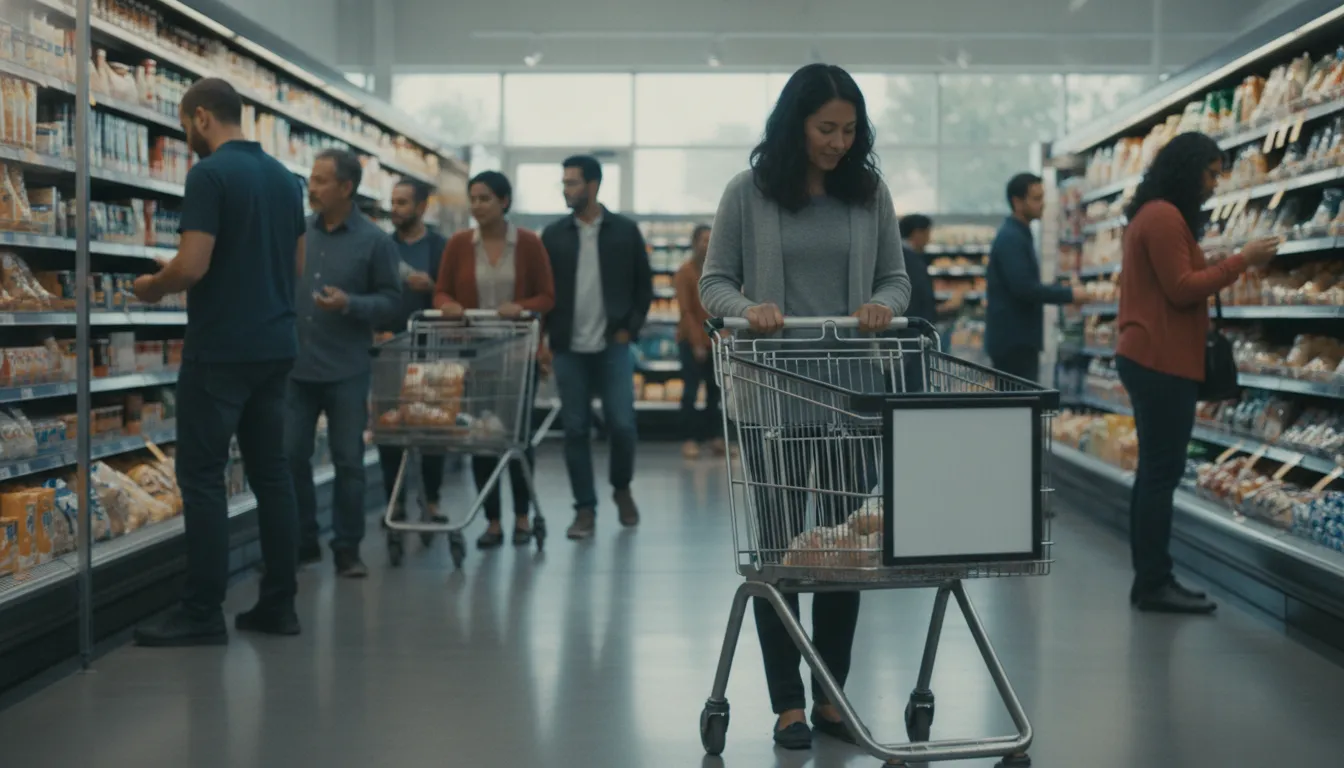
A grocery cart is not just a transport tool. It moves through aisles, product categories, and decision points. It gives marketers a physical format that can stay relevant to the shopping environment without relying on a fixed billboard or a digital feed. The planning challenge is matching that format to the audience, store footprint, creative objective, and broader media mix.
Talk with All Points Media about building a retail audience plan. Call (503) 626-0669.
Shopping cart advertising places a branded unit on a cart, typically at the front, with related options such as directory or header placements. It can support local, regional, or national retail programs, but its value should be assessed alongside venue context. Product proximity, mobility, creative fit, and the exposure data available for the specific program.
All Points Media treats cart placements as one option within a wider in-store and place-based strategy. That perspective keeps the focus on the media decision: where the format fits, who it can reach, and how it works with other environments. Start with the placement itself, then build the planning framework around its role in the shopper journey.
What Is Shopping Cart Advertising?
Shopping cart advertising places a branded advertising unit on a shopping cart used inside a grocery, drug, or other retail store. Unlike a static message positioned at the edge of a property. The format moves through the shopper's store journey and stays close to the products, aisles, and purchase decisions that define the environment. The format is best evaluated as a contextual retail placement, not as a guaranteed attention or conversion device.
Common shopping cart placements
Available units vary by operator and cart design. Programs commonly include three placement types:
- Front placement: A larger panel attached to the front of the cart, giving the creative a clear shopper-facing position.
- Directory placement: A smaller format integrated into the cart's directory area, where shoppers may look for store information.
- Header placement: A compact panel positioned higher on the cart, with different viewing conditions and creative requirements.
AdCart lists front, directory, and header placements as distinct inventory options, with dimensions that vary by format. Marketers should confirm available specifications, production requirements, and installation standards with the operator before finalizing creative. That step prevents a media idea from being forced into a format it was not designed to fit.
Where cart media fits in the plan
Cart units can support a retail or grocery strategy when proximity to products, store context, and a physical shopper environment matter. They may be planned alongside other point-of-purchase formats, retail media, or broader place-based placements rather than treated as a complete media plan on their own. See how retail media and place-based advertising differ when choosing the role each channel should play.
For brands planning beyond a single store group, grocery store advertising networks can provide a broader framework for evaluating venue selection, geography, audience fit, and execution. All Points Media approaches that planning through custom network building, aligning venues and formats with the campaign's objective instead of selling only a fixed list of placements.
Shopping cart advertising is a mobile, in-store format placed on grocery, drug, or other retail carts. Front, directory, and header units offer different creative contexts. The format is most useful when planned as one component of a broader retail and place-based strategy, with placement, audience, geography, and execution evaluated together.
How Do Dwell and Frequency Shape Cart Media?
Cart media earns its planning value from the context of the shopping trip. The unit moves through aisles, departments, and checkout rather than remaining in a single position. The relevant questions are how long shoppers remain in the store, how often they return, and whether the placement fits the campaign objective. That does not mean every shopper sees a cart ad for the same duration or with the same level of attention.
One industry source reports that the average supermarket visit lasts 45 to 60 minutes and that the average shopper visits the market two to three times per week. Those figures are a third-party example, not a universal benchmark, and they are not cart-specific exposure or frequency measurements. They should be used to frame planning questions, not to promise a number of impressions or attentive views. The source also describes the cart as present throughout the shopper trip, but that positioning should not be converted into a guaranteed-attention claim.
Plan frequency around the audience and market
Repeat visits can make shopping cart advertising relevant for campaigns that need a recurring local presence, such as seasonal retail promotions, product awareness, or community-based messaging. Frequency planning still requires a defined geography, store set, flight length, and audience rationale. A neighborhood program may call for a different store mix and cadence than a regional brand campaign. The right schedule depends on the objective and the available inventory, not on a universal grocery-shopping average.
That distinction matters as grocery behavior becomes more omnichannel. The USDA reports that about one in five people who usually shop for groceries in their household purchased groceries online at least once in the prior month. More than two in five online grocery shoppers cited time constraints as the main reason. These findings describe grocery behavior broadly; they do not establish cart exposure. They suggest that an in-store plan should be considered alongside the role of digital, pickup, delivery, and other retail touchpoints.
All Points Media can place cart media inside a broader grocery store advertising network or custom place-based plan, with reach, frequency, audience fit, venue context, geography, and reporting evaluated together. That approach keeps dwell and repeat exposure useful as planning inputs without treating them as performance guarantees.
Dwell and frequency help media buyers evaluate where cart placements may fit. But third-party averages of 45 to 60 minutes per visit and two to three visits per week are neither universal nor cart-specific. Use them as context, then build frequency from the audience, stores, geography, flight, objective, and available reporting.
How Should Marketers Target Shopping Cart Advertising?
Effective planning starts with the audience and shopping context, not with a predetermined list of stores. Define who the campaign must reach, where those consumers shop, what action the media should support, and how cart placements will complement the rest of the plan. Shopping cart advertising can then function as a precise retail touchpoint rather than an isolated format purchase.
Start with audience and store context
Translate the brief into observable retail signals: geography, trade area, store type, shopping mission, and proximity to the purchase environment. A campaign for a regional grocer, for example, may need to prioritize shoppers around specific stores and neighborhoods. A consumer packaged goods brand may need broader coverage across a selected set of retail environments. The objective is not to assume that every shopper is interchangeable, but to curate locations where the audience and the product context plausibly align.
For a broader plan, review how retail audience activation connects physical shopping environments to campaign strategy. That lens helps buyers assess cart media alongside other retail and place-based opportunities.
Match geography to the business objective
Retail campaigns may be local, regional, or national. Local targeting can be organized around cities, neighborhoods, ZIP codes, trade areas, individual stores, competitive conquesting, or community priorities. Regional programs can use a state, a group of markets, or a DMA cluster. National planning can extend across all 50 states and 210 DMAs when the audience and distribution footprint justify that scale.
Store selection should follow the business problem. A local retailer may need community visibility or support for a store opening. A multi-market brand may need consistent presence around priority trade areas. A national advertiser may use cart placements as one layer in a larger custom network, with other venues added where the audience spends time outside the store.
Align scale and objective before buying
Clarify whether the role is awareness, consideration, direct response, or brand building. Then evaluate the proposed network by audience fit, geographic coverage, venue context, reach, frequency, and reporting, without inserting unsupported cart-specific exposure estimates. All Points Media builds custom networks in high-dwell and high-engagement environments across all 50 states and 210 DMAs. Allowing cart placements to be considered alongside other relevant environments rather than treated as fixed, standalone inventory.
The practical advantage is operational as well as strategic. All Points Media can support strategy, venue procurement, production, installation, campaign management, and proof-of-performance reporting through a turnkey model. Buyers can therefore compare a cart-led plan with retail media and place-based advertising using the same audience and measurement logic.
Target shopping cart advertising by connecting audience, store or trade area, campaign objective, and required scale. Local programs can focus on ZIP codes, stores, and communities, while regional and national plans expand market coverage. Treat carts as one component of a custom retail and place-based network, not a guaranteed exposure benchmark.
What Makes Shopping Cart Creative Effective?
Effective cart creative starts with the physical context, not a resized display ad. A front placement, directory placement, and header placement occupy different positions on the cart and are viewed at different moments. Providers may offer all three formats, but the available frame and production requirements should be confirmed with the operator before design begins. See the format examples at AdCart.
Design for the viewing context
The front of the cart typically offers the clearest canvas for a primary message. Use a short headline, strong brand identification, and one visual idea that remains legible while the cart is moving through the store. Directory placements may support a more informational message, such as a location cue or product category. A header placement has less room to carry detail, so it should function as a quick brand or offer reminder rather than a compressed brochure.
Across formats, establish a clear hierarchy: brand first, audience-relevant benefit second, and one action third. Avoid stacking several offers, qualifiers, URLs, and product claims into a small surface. If the campaign depends on a promotion, state the offer plainly and make the next step easy to understand. The CTA might direct shoppers to a nearby location, a landing page, a limited-time event, or a simple branded action. The right choice depends on the campaign objective, not on a generic cart-media template.
Connect the message to the product moment
Cart media has a practical advantage: it travels through a retail environment alongside the shopping journey. That proximity can make a message more relevant when it supports the store visit, product category, seasonal need, or local context. It does not guarantee attention or purchase, so the creative should earn relevance rather than rely on assumed exposure. Audience, venue, geography, and objective should determine whether the message is broad brand building or closer to a point-of-purchase prompt.
Production confirmation is part of creative strategy. Confirm the approved format, usable area, color and file requirements, installation process, flight dates, and any operator restrictions before final delivery. All Points Media's turnkey model connects strategy, venue procurement, creative production, installation, campaign management, and proof-of-performance reporting, reducing the risk of disconnected handoffs. That operating model is especially useful when a campaign spans multiple markets or retail environments.
Plan the proof-of-performance handoff
Define reporting expectations before launch. The handoff should identify the participating locations or network, flight timing, installed formats, creative version, and the evidence available after installation. Evaluate the placement alongside the broader plan using audience fit, geographic coverage, venue context, and reporting, rather than attributing an unsupported outcome to the cart unit alone. For broader planning context, compare retail media and place-based advertising as complementary tools.
Strong shopping cart creative matches the message to the cart placement, prioritizes legibility and one clear action, and connects the offer to the retail context. Confirm format and production requirements with the operator, then document locations, timing, installation, and reporting so the creative can be evaluated as part of the full media plan.
Shopping Cart Advertising vs Other In-Store Media
Shopping cart advertising is most useful when its role is defined against the rest of the retail media mix. A cart unit moves through the store and stays close to the shopper, while shelf and floor placements are anchored to specific product zones. Sampling introduces a live interaction, digital in-store media adds motion and scheduling flexibility, and broader place-based networks extend the campaign beyond one retail environment.
All Points Media recommends comparing formats by audience fit, mobility, product proximity, venue context. Geographic coverage, creative flexibility, repeat exposure, and reporting rather than treating every in-store impression as interchangeable. The right choice depends on whether the objective is awareness, consideration, direct response, or brand building.
| Format | Best strategic role | Key planning consideration | Measurement question |
|---|---|---|---|
| Shopping cart advertising | Carry a consistent brand message through the shopping journey. Keep the creative near the shopper. | Match the placement, message, and store set to the audience and campaign objective. Confirm format requirements with the operator. | Which stores, audience segments, and campaign periods align with the intended reach and repeat-exposure plan? |
| Shelf and floor media | Connect a message to a product category, aisle, or point-of-purchase decision. | Prioritize proximity to the relevant product or traffic path, while accounting for local store layouts and visibility. | Did the placement reach the intended category context and support the desired shopper action? |
| Sampling | Create a product trial or human interaction when experience is central to the objective. | Plan staffing, permissions, scheduling, product handling, and venue operations alongside the media strategy. | How many qualified interactions occurred, and what follow-up or response signals can be captured? |
| Digital in-store media | Deliver scheduled, motion-led, or frequently refreshed creative within selected retail environments. | Assess screen location, loop placement, creative duration, sound policy, and the reporting available from the operator. | Where and when did the message run, and how does delivery map to the planned audience and schedule? |
| Broader place-based networks | Build a custom mix of venues and formats around an audience, geography, and campaign objective. | Balance scale with venue relevance, execution consistency, creative adaptation, and proof-of-performance requirements. | Does the network provide the intended coverage, audience alignment, venue context, and campaign reporting? |
For marketers planning beyond a single store format, retail media and place-based advertising can clarify how owned retail environments and custom physical networks work together. Brands focused specifically on grocery environments can also evaluate grocery store advertising networks as part of a wider retail plan.
Shopping cart advertising offers mobility and close product context, while shelf, floor, sampling, digital, and broader place-based formats solve different planning problems. Choose by audience, venue, objective, creative fit, geographic scale, and reporting needs, then combine formats when one placement cannot provide the required context or coverage.
Discuss a custom retail media mix with All Points Media. Call (503) 626-0669.
Frequently Asked Questions
What factors influence the cost of shopping cart advertising?
Cost planning typically depends on the selected stores, cart inventory, placement type, campaign duration, geography, production, installation, and reporting requirements. Some providers describe pricing as tied to the number of carts at a store and the campaign requirements. So request a market-specific proposal rather than applying a generic rate. Review provider-level pricing considerations.
Can shopping cart advertising support a local retail campaign?
Yes. A local program can be planned around cities, ZIP codes, trade areas, specific stores, competitive locations, or community priorities. The strongest approach starts with the audience and campaign objective, then selects stores that align with the intended market instead of treating every grocery location as interchangeable.
What creative requirements should marketers confirm before production?
Confirm the available placement, final dimensions, viewing angle, material specifications, production deadline, and installation process with the operator before designing. Front, directory, and header placements can differ in size and context, so creative should prioritize quick comprehension, strong contrast, a focused message, and a clear next action.
How should cart placements fit into a broader media plan?
Use cart placements when mobility through the store, proximity to products, and recurring venue context support the objective. Compare them with shelf, floor, sampling, digital in-store, and broader place-based formats by audience fit, geographic coverage, creative flexibility, repeat exposure, and reporting. A mix may provide stronger coverage than any single format.
Get started with a retail audience plan
All Points Media can help connect your retail or grocery objectives with the audiences, markets, and place-based environments that fit your media plan. A focused conversation can clarify whether cart placements should stand alone or work alongside other in-store and place-based formats. Contact All Points Media to discuss your campaign, or call (503) 626-0669.