
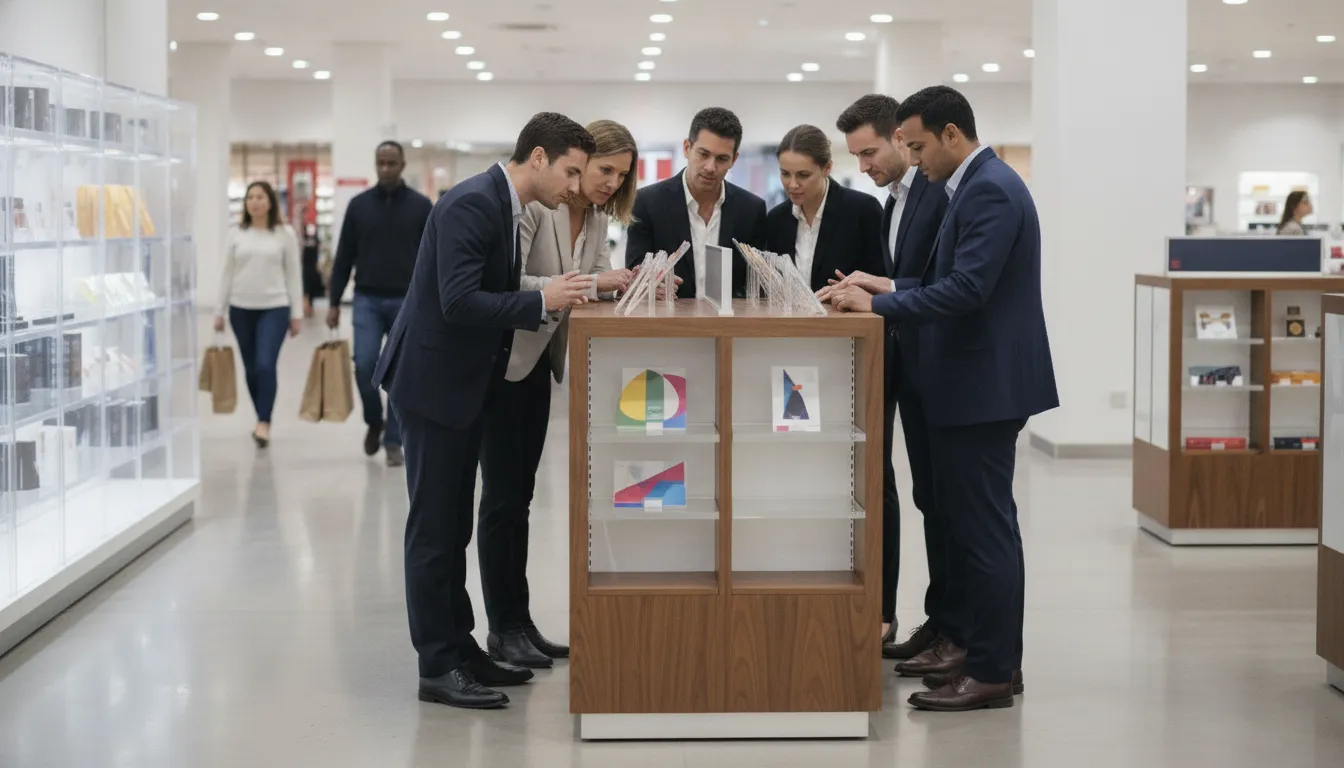
The last few feet before a purchase are not a single media moment. A shopper may encounter a shelf-edge message while comparing products, a floor unit while moving through an aisle, or a counter display while waiting to check out. Each placement creates a different brief for the creative, the venue, and the campaign team.
Point of purchase displays are physical or digital messages positioned throughout the shopping area to influence attention and provide context near a product or decision. Point-of-sale materials sit at the transaction point. The right choice depends on audience behavior, environment, objective, and execution requirements.
For media buyers and brand marketers, the strategic question is not simply which fixture looks most prominent. It is how format, placement, timing, and venue mix work together to make a message relevant in the real-world path to purchase. Start by separating the display formats from the shopper moments they are designed to support.
What Are Point of Purchase Displays?
For media buyers. Point of purchase displays are physical or digital marketing displays placed in a retail environment to promote a product and influence the shopper's decision close to the moment of purchase. They can be as compact as a shelf-edge card or as substantial as a two-sided shelving unit, giving planners a broad range of physical footprints and creative possibilities.
The distinction between point of purchase, or POP, and point of sale, or POS, is useful when defining campaign scope. POP refers to displays positioned throughout the shopping area, while POS specifically identifies the place where a transaction occurs. A shelf talker in an aisle, a branded unit near an entrance, and a display on an endcap can all function as POP. A counter display beside the register sits closer to the POS environment, but the terms are not always used consistently across suppliers.
That distinction matters because the display's job changes with its context. A fixture encountered while someone is entering or navigating a store can establish awareness, frame a product category, or direct attention toward a specific area. A display positioned near checkout operates later in the shopping journey, when convenience, relevance, and an easy add-on decision may matter more. The same creative idea can therefore require different dimensions, messaging, and production specifications depending on where it appears.
For All Points Media, the broader planning question is not simply whether a brand can place a fixture in a store. It is how a physical touchpoint fits an audience, environment, geography, and campaign objective. That audience-first approach connects POP thinking to place-based media campaigns, where the environment is part of the media decision rather than a neutral container for an advertisement.
In practical terms, point of purchase displays are best evaluated as environmental media assets. Their value depends on visibility, proximity to the relevant product or action, creative fit, and the shopper moment they occupy. Defining the display correctly is the first step; selecting the right context determines whether it has a meaningful role in the campaign.
Which Point of Purchase Display Formats Fit the Campaign?
For All Points Media, format selection is one part of matching a physical environment to an audience, objective, and campaign duration. Point of purchase displays can range from simple shelf talkers to digital screens, with temporary, semi-permanent, and permanent executions available depending on the brief. The right choice is less about choosing the most elaborate fixture and more about aligning visibility, product access, installation requirements, and shopper context.
| Format | Best use | Strengths | Planning watchout |
|---|---|---|---|
| Shelf-edge or shelf talker | Supporting a product at the shelf or calling attention to a specific offer. | Compact, close to the product, and relatively simple to deploy. | Limited surface area means the message and visual hierarchy must work at close range. |
| Floor-standing unit or dump bin | Creating a dedicated product presentation in a floor position, launch area, or high-traffic zone. | More physical presence, product capacity, and separation from the main shelf. | Confirm footprint, stability, replenishment, and retailer requirements before production. |
| Countertop | Reaching shoppers at checkout counters, service points, or other constrained surfaces. | Uses a smaller footprint and places the message or product within hand and eye range. | Counter space is limited, so dimensions, stocking, and operational permissions matter. |
| Hanging or back-lit | Building overhead visibility or creating a stronger visual cue in a defined environment. | Can improve sightlines and add dimensional or illuminated presence. | Account for mounting, clearance, power, safety, and venue-specific installation rules. |
| Digital | Delivering motion, changing creative, or time-sensitive messaging. | Supports flexible content and can create a more dynamic presentation than static print. | Technology, content operations, power, and maintenance add planning dependencies. |
| Shelf-ready packaging | Combining product transport and presentation at the shelf. | Can streamline the transition from shipment to display while preserving branded visibility. | Validate product dimensions, structural needs, retailer specifications, and stocking workflow. |
These categories reflect common display options identified in industry format guides, including shelf talkers and digital screens, floor-standing and countertop units, hanging and back-lit signage, and shelf-ready packaging. Format selection should account for product weight and dimensions, retailer requirements, durability, technology, customization, and the time available for sourcing and assembly. Basic cardboard setups may be faster to source, while more durable or technical executions require earlier coordination.
How Does Placement Change the Shopper Moment?
Placement determines what kind of attention a display can earn and when that attention occurs. An entryway display introduces a message before the shopper has selected a path. An aisle display reaches people already navigating a category. An endcap can interrupt that route at the aisle entrance, while a center-aisle fixture creates a freestanding encounter in a higher-traffic part of the store. These are different media moments, not interchangeable pieces of real estate.
Checkout counters and impulse zones operate later in the journey. They can support last-minute consideration, add-on prompts, or a final reminder after the shopper has completed most of the trip. Industry guidance explicitly distinguishes these roles: entryways build early awareness, endcaps capture attention before an aisle, and checkout placements address last-second decisions. The appropriate objective depends on the audience, product, message, and retailer environment, not simply on which location appears most prominent.
Research supports a disciplined approach rather than a promise of automatic sales. One in-store experiment associated middle-shelf placement with the highest purchase percentage among the shelf positions tested. But its authors noted that the relationship between shelf height and increased sales was not unequivocal. A separate supermarket eye-tracking study found that attention reflected both display-related factors, such as placement and facings, and shopper preferences. Visual saliency alone did not explain the full picture.
For media buyers, that means evaluating the shopper context around the fixture. Is the audience entering with time to orient, comparing products in an aisle, passing a high-traffic intersection, or waiting at checkout? All Points Media can use that behavioral lens when shaping audience strategy and considering how a venue network fits a broader campaign. The goal is to align placement with the moment the message needs to matter, then measure the result without overstating what placement alone caused.
How Should Media Buyers Plan a Point of Purchase Display Campaign?
All Points Media recommends treating the display as one component of a planned audience experience, not as an isolated fixture. The workflow below keeps the media objective, physical environment, and execution requirements aligned from brief through reporting.
- Define the campaign objective. Decide whether the assignment is intended to build awareness, support a product launch, explain an offer, prompt an add-on consideration, or reinforce a broader campaign. The objective determines what the display must do in the shopper journey and what evidence will matter later. Keep the brief specific enough to guide placement and creative, without assuming that a display alone will produce a particular sales outcome.
- Map audience behavior and the relevant moment. Identify who needs to encounter the message, what they are doing in the environment, and how much attention the setting allows. An entry point, aisle, endcap, and checkout area each represent a different shopper moment. Audience strategy should connect behaviors to environments, rather than relying on demographic assumptions alone.
- Select venues and placements. Evaluate the audience fit, geographic coverage, dwell characteristics, and operational conditions of each venue. Location also constrains the structural format: floor positions may suit floor-standing units, dump bins. Or pallet-wrap displays, while a counter or checkout position may call for a counter display unit. See how custom networks can organize venue selection around the campaign rather than a fixed inventory list.
- Match format and creative to the environment. Confirm product weight and dimensions, available footprint, retailer requirements, budget, durability, and the expected campaign duration before selecting the format. Then build creative for the viewing distance and attention window. A concise message, clear brand cues, and an appropriate physical or digital treatment are more useful than adding complexity that the venue cannot support.
- Plan geography, timing, and field requirements. Set the rollout by market, venue group, and campaign window. Document production specifications, approvals, delivery, installation, planogram compliance, stocking, and maintenance responsibilities. Launch timing and consistent upkeep are part of media planning, not administrative details. For national, regional, or local work, define how the same strategic idea will be adapted without losing execution consistency.
- Define measurement before launch. Establish the baseline, exposure or placement evidence, and outcome indicators that correspond to the objective. Depending on the campaign, reporting may include installation confirmation, venue-level delivery, audience or traffic context, engagement signals, or an appropriate sales analysis supplied by the client or retailer. Avoid treating visual prominence as proof of effectiveness. A useful measurement plan makes the limits of the available data explicit and supports the next planning decision.
What Makes Point of Purchase Displays Work in the Field?
A strong concept can fail between approval and deployment. Field execution depends on whether the display is engineered for its environment, accepted by the retailer, installed on schedule, and maintained long enough to remain presentable and useful. That operational layer is especially important when a campaign spans multiple locations with different footprints, staff routines, and compliance requirements.
Build to the environment, not just the artwork
Production specifications should begin with the placement and the product. Weight, dimensions, available floor or counter space, durability, budget, and retailer requirements all influence the appropriate structure and materials. Display costs also vary with durability, technology, and customization, while basic cardboard setups are generally faster to source and assemble than more complex builds. Those tradeoffs should be resolved before creative is finalized, not after a production file is approved. See production and installation support for the role of coordinated execution.
Protect the launch and the shopper experience
Retailer approvals and planogram requirements are not administrative details. They determine where the unit can sit, how it may be stocked, what products or messages belong in each position, and whether the installation meets the agreed brief. A field-ready rollout should include delivery dates, installation instructions, stocking ownership, escalation contacts, and a maintenance schedule. Industry guidance identifies on-time launch, planogram compliance, product availability, and upkeep as core execution factors during a promotion.
Keep the message consistent, then measure what happened
Consistency matters when a shopper encounters the same campaign across locations or over time. An interactive display study found an immediate knowledge effect, but not a significant follow-up difference, suggesting that continued message presence may help reinforce understanding. That finding is not a conversion guarantee. It is a practical reason to define campaign duration, replacement standards, and message continuity in advance.
Measurement should combine deployment evidence with the campaign objective: confirmed locations, installation dates, photographic proof, condition checks, stock status, and any available audience or engagement signals. All Points Media supports planning, production, installation, campaign management, and proof-of-performance reporting. Allowing field activity to be reviewed against the original brief rather than assumed from a creative approval alone.
Where Do Point of Purchase Displays Fit in a Broader Place-Based Plan?
A point-of-purchase display is one touchpoint in one environment. A broader place-based plan starts with the audience, then identifies the venues and moments where that audience can encounter a message. That distinction matters when a campaign needs more than a single fixture, retailer, or store cluster.
All Points Media builds place-based media campaigns around audience demographics and behaviors, geographic coverage, campaign objectives, duration, budget, creative impact, and brand fit. A display may be relevant in a retail environment, but the planning question is whether that environment belongs in the right venue mix for the audience and objective.
That mix can combine static and digital formats across diverse venue categories. Static signage may provide a consistent physical presence, while digital placements can support changing creative or messaging. The right combination depends on how people move through the selected environments, not on an assumption that every campaign needs every available format.
From one fixture to a custom venue network
A single display usually requires decisions about its physical format, placement, retailer requirements, and field execution. A custom network adds another layer: selecting and coordinating multiple venues or locations that collectively support the campaign's geographic and audience strategy. Campaigns may be national, regional, or local, with the rollout shaped around the brief rather than a fixed inventory menu.
An audience and venue strategy partner is useful when the campaign spans markets, requires multiple venue types. Or needs one accountable team to manage planning, production, installation, campaign management, and proof-of-performance reporting. All Points Media's venue network approach is relevant at that planning level. It does not require treating a point-of-purchase fixture as an All Points Media product.
Frequently Asked Questions
What is a point of purchase display?
A point of purchase display is a physical or digital marketing fixture positioned in a shopping environment to present a product and support a purchase decision. It can appear across the shopping area, while a point-of-sale display is specifically associated with the transaction location, such as a checkout counter. Shopify distinguishes the two terms.
What are some examples of point of purchase displays?
Common examples include shelf talkers, shelf-edge cards, dump bins, floor-standing units, countertop displays, hanging signs, endcap fixtures, back-lit panels, digital screens, and motion-activated displays. The right format depends on the product, available footprint, shopper moment, campaign duration, and retailer requirements.
What are retail point-of-purchase displays?
Retail point-of-purchase displays are fixtures or signs used inside stores to promote products where shoppers can see, consider, or select them. Entrances can build early awareness, endcaps can capture attention before an aisle visit, and checkout placements can support last-minute decisions. Execution also requires timely launch, planogram compliance, replenishment, and maintenance.
How much does a POS display cost?
There is no single standard price. Cost varies with the display's durability, technology, customization, materials, size, production quantity, installation needs, and retailer specifications. Basic cardboard setups are generally faster to source and assemble, while more durable, digital, or highly customized formats require a different production and budget plan.
Ready to Discuss Your Point-of-Purchase Campaign?
Contact us to discuss a custom campaign, or call (503) 626-0669 to talk with All Points Media.