
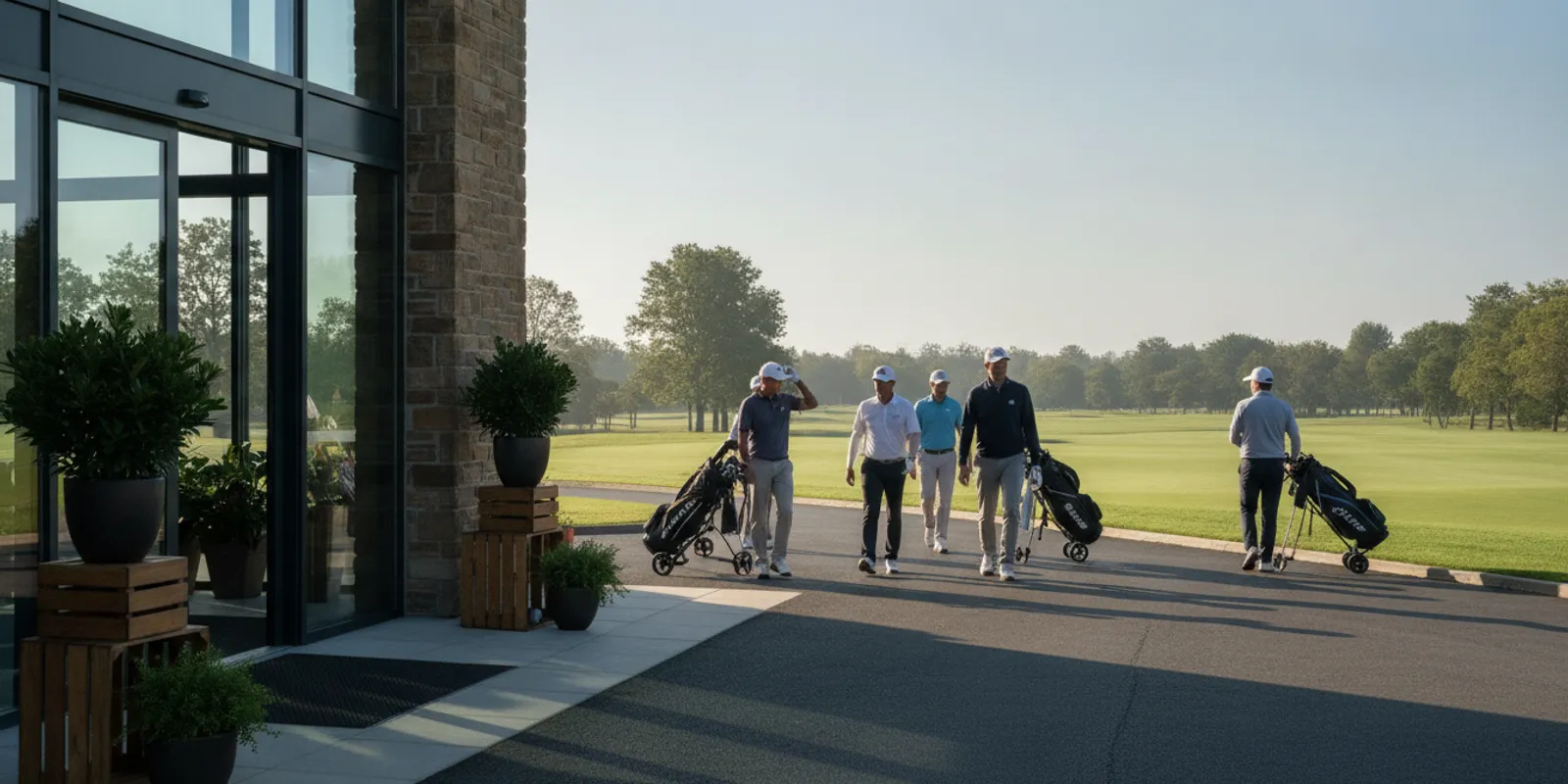
Unique golf marketing ideas work best when they are built around the moments golfers already spend at a course, rather than added as noise. For brand and agency buyers, the opportunity is to match a useful message, format, and location to a specific audience and campaign goal.
What makes a golf marketing idea useful to a campaign buyer?
A distinctive idea is not simply an unusual sign or a clever giveaway. It connects a brand to a relevant moment, gives people a clear reason to notice or interact, and can be executed in a way that fits the venue. A concept should also be explainable to a client: who it is intended to reach, what people will see or do, and how the team will assess delivery.
Start with the campaign objective. Is the priority awareness, a product demonstration, a local offer, event attendance, or a conversation with a specific audience? Each goal points to a different format. A static display may suit a concise reminder. A staffed activation may make sense when explanation or sampling is central. A mobile unit can bring a campaign to an event or selected location. The format should follow the objective, not the other way around.
Golf can also be considered in a broader participation context. The National Golf Foundation reports a record-setting total that included 29.1 million people who played on a golf course and another 19 million who participated exclusively in off-course golf. That distinction matters to planning: a campaign aimed at on-course players may need different venues and creative from one intended for people who visit simulators or other off-course settings. Read the National Golf Foundation’s golf industry facts.
Which golf moments can a campaign use?
Map the experience before selecting placements. A course visit may include arrival, check-in, warm-up, play, a break, and time in the clubhouse. Not every property has the same layout or audience flow, so treat these as planning prompts to validate with each venue.
- Arrival: A clear welcome or orientation message can introduce a sponsor or service before play.
- Waiting and check-in: A concise message can be placed where people have time to look, if the venue approves the placement.
- Practice: Warm-up areas provide a context for products or services related to comfort, hydration, equipment, or preparation.
- Breaks: Clubhouse dining and lounge areas can support longer-form information or a simple offer.
- Departure: A follow-up prompt can direct interested visitors to a landing page or nearby destination.
Use this journey to identify a small number of meaningful touchpoints. Repeating the same message at every available surface may create clutter. A better plan gives each placement a role: introduce, explain, invite, or remind.
What unique golf marketing ideas can brands test?
1. Create a useful arrival moment
Instead of treating the entrance as a logo wall, make the first interaction useful. A sponsor might support a simple course-day guide, a weather-ready checklist, or an orientation message that helps visitors understand where to go. The brand should be clearly identified, but the service to the visitor is the reason to pay attention.
For a campaign buyer, the test is straightforward: does the message solve a small arrival question without competing with venue operations? Confirm who owns the information, how often it changes, and who approves the final copy. Keep directions and essential venue notices easy to distinguish from advertising.
2. Offer a practice-area prompt tied to the moment
Warm-up is a natural setting for an idea related to preparation. A brand could offer a brief tip, a demonstration, or a product trial, subject to venue rules and the campaign’s category. Keep instructions short enough to understand between practice activities. If a QR code is included, explain what visitors will get after scanning it instead of presenting an unexplained code.
Consider whether the concept needs an attendant. A self-guided display is simpler to run, while a staffed demonstration needs scheduling, venue approval, staffing, and a plan for setup and cleanup. Decide this before creative production begins.
3. Make a clubhouse message serve a real decision
Clubhouse messaging can be more than a generic brand impression. It might point to a nearby retailer, explain a local service, or provide a simple offer relevant to the break. A table card or display should lead with one useful idea and one next step, not a dense list of features.
Be precise about the intended audience. A local business may want to reach people who live or work nearby; a national brand may use the location as one part of a wider campaign. If the offer is time-limited, confirm dates and redemption conditions before distribution. Make sure the venue is comfortable with the call to action and how it affects its guest experience.
4. Build a small, venue-approved discovery trail
A discovery trail can connect two or three approved locations around a property. Each station carries a short prompt or piece of a story, with an optional digital destination for people who want more. The theme could be product education, a local community message, or a low-pressure contest. The experience should remain optional and must not interfere with play, staff duties, or safety instructions.
Keep the mechanics simple. Decide where the trail begins and ends, how a participant knows what to do, what information is collected, and how long the materials stay in place. Avoid collecting personal information unless there is a clear need and an approved, transparent process. A short route with a coherent story is easier to manage than many disconnected stops.
5. Pair a physical placement with a useful digital follow-up
A physical message can introduce an idea, while a mobile page offers details that would not fit on a small display. That page might explain a product, provide event information, or let a visitor save an offer. Use a unique campaign link or QR destination only when the team can maintain it and has agreed on what activity it will report.
Check the complete visitor path before launch: code readability, page loading on a phone, offer terms, accessibility, and what happens after the campaign ends. Do not imply that a scan proves a sale or identifies an individual. Treat digital response as one possible signal alongside placement delivery and other agreed measures.
6. Bring an AdVan-style activation to a golf event
A mobile digital billboard can extend an event presence beyond a fixed display. For example, a campaign team could explore a mobile screen experience for a permitted event area, with concise creative and a schedule coordinated with the organizer. Audio or interactive elements should be considered only when appropriate for the setting and explicitly approved. An event activation is a different planning question from putting advertising around a course; it needs route, timing, access, power, staffing, and sound decisions.
All Points Media describes its AdVan media offering as a mobile billboard format. Buyers considering a mobile component should ask how the route and operating plan will fit the event and what documentation will be available after execution.
7. Connect golf participation to a local community story
A brand can support a community message that is relevant to the course’s location, such as a local nonprofit initiative or a public information effort. The creative should state the connection plainly and make the requested action realistic. If a charitable partner is involved, agree on how the relationship is described and obtain approval for names and marks.
This approach can feel more grounded than a broad national message, but only if the partnership is genuine and the venue welcomes it. Confirm that the campaign does not suggest an endorsement or donation arrangement that has not been formally agreed.
8. Design a quiet, premium service touchpoint
Some audiences respond better to a restrained placement than a high-energy activation. A brand might support a useful amenity or an understated information point in a lounge or waiting area. The idea is to make the service recognizable without overwhelming the environment. Work with the venue on placement, materials, upkeep, and whether the display should be removed outside campaign dates.
This format calls for careful creative review. Use legible type, a short headline, and a single action. If visitors need staff help to redeem something or receive a service, explain that clearly so the message does not create friction for venue employees.
9. Build a campaign around a calendar moment, not just a tournament
Golf settings are not limited to tournament sponsorship. A campaign can align with the start of the season, a community open day, a product launch, or a relevant local date. The opportunity is to develop an idea suited to the occasion without relying on generic event signage. Consider a short-run installation, a demonstration, or an educational message that fits the calendar and the property’s schedule.
Start with the venue calendar and operational constraints. Ask what dates are available, whether a competing event or sponsor already has category rights, and how much time is needed for approvals and installation. A well-timed, simple idea is more practical than a large activation that cannot be supported on-site.
10. Use a creative sequence across approved touchpoints
Instead of repeating one ad, use a sequence: a first placement introduces a question, a second provides a short answer, and a final one invites a next step. The sequence could move from arrival to clubhouse, or from a permitted event area to a follow-up page. Each piece should work on its own in case a visitor sees only one part.
Make the order and timing explicit in the plan. The creative team should know which message appears where, and the operations team should know the approved locations and changeover dates. If the venue cannot support the full sequence, the remaining placements still need to make sense as a standalone campaign.
How should buyers compare golf campaign ideas?
Use a comparison table to evaluate the role, execution needs, and main planning question for each concept. The table is a starting point, not a claim that every course offers every format. Confirm each option with the venue and campaign partner.
| Idea | Best suited to | Execution needs | Question to resolve |
|---|---|---|---|
| Arrival guide | Orientation or awareness | Approved location, concise copy, current information | Who maintains directions and updates? |
| Practice-area prompt | Product education or trial | Venue permission; staffing if demonstrated | Can the interaction fit without disrupting practice? |
| Clubhouse offer | Local action or consideration | Clear terms, readable creative, staff awareness | How will visitors redeem or learn more? |
| Discovery trail | Engagement or education | Few approved stations, simple route, upkeep plan | Does the experience remain optional and safe? |
| Mobile event activation | Event visibility or demonstration | Organizer approval, route and schedule, operating plan | Where can the unit operate, and what is documented? |
| Creative sequence | Message reinforcement | Coordinated creative, placement map, changeover dates | Does each placement make sense on its own? |
Compare concepts against the same brief rather than judging by novelty alone. Rate each option for audience fit, visitor value, venue feasibility, creative complexity, time, and the evidence the campaign team can provide. A useful concept that a property can approve and maintain is usually a stronger starting point than an ambitious idea with unresolved operating details.
How should a golf idea scale across venues?
A concept that works at one property may need adjustment before it can be repeated elsewhere. Even when the campaign objective stays the same, the physical layout, visitor flow, available surfaces, event calendar, and approval process can vary. Build a repeatable framework, not a rigid placement assumption.
Separate the campaign into elements that should stay consistent and details that may change. The core message, brand identity, offer terms, and reporting definitions often need tight control. The precise location, supporting information, format, or timing may need to respond to venue conditions. Document those boundaries so local adjustments do not change the campaign promise or create conflicting versions of the creative.
For a multi-market program, ask for a placement plan that identifies confirmed locations, proposed dates, and any conditions still awaiting approval. Establish how substitutions will be handled if a property becomes unavailable. If a market has fewer suitable venues than expected, decide in advance whether the campaign should use a different approved location, shift timing, or reduce the planned scope. This avoids treating every late change as an emergency.
A limited pilot can help expose practical questions before a wider rollout, but define what the pilot is meant to learn. It might test whether the creative is understandable, whether the interaction fits the setting, or whether installation and documentation procedures are workable. Do not label a small pilot a performance test unless the plan can support that conclusion. Record observations, agree on any changes, and then apply those lessons deliberately to the next phase.
Consistency also depends on a clear chain of responsibility. Identify who approves creative, who communicates with each venue, who checks installation, and who reports issues. When several partners are involved, one shared schedule and a single approved asset set can reduce avoidable confusion. A turnkey campaign partner may coordinate these elements, but the scope and deliverables should still be spelled out in the proposal.
What should go into a golf campaign brief?
A concise brief makes it easier to evaluate venue and format options. Include the following before requesting a proposal:
- Objective: State whether the campaign is intended to build awareness, explain an offering, prompt an action, or support an event.
- Audience: Describe who matters and whether the focus is local, regional, or national. Separate on-course and off-course audiences if both are relevant.
- Geography and timing: Identify priority markets, campaign dates, flexibility, and any important event windows.
- Creative: Provide approved copy, formats, calls to action, offer details, and any requirements for brand or partner approval.
- Operations: Note whether the plan needs installation, staffing, samples, interactive elements, or removal after the flight.
- Measurement: Agree what counts as delivery evidence and what response signals, if any, will be reviewed.
All Points Media’s campaign project idea form is a useful route for organizing an initial campaign conversation. If printed materials are part of the concept, review the company’s advertising print production services as part of production planning. For broader context on custom venue programs, see the place-based advertising overview.
How can buyers avoid common planning mistakes?
Do not assume every property has the same inventory. Courses differ in layout, operations, and permissions. Treat proposed placements as options to confirm, not as a universal package.
Do not make the creative carry too many messages. A small placement should focus on one idea and one next step. Put supporting information on an approved digital destination if appropriate.
Do not confuse activity with an outcome. A scan, conversation, or sample distribution can be a response signal, but it does not automatically establish sales impact. Set expectations for reporting before the campaign starts.
Do not leave venue staff out of the plan. Explain what is being installed, who handles questions, and what to do if materials need attention. For campaigns involving several markets or properties, establish a single approval process and a record of the final creative.
Do not overlook adjacent venue possibilities. If the target includes off-course participants, ask whether other relevant settings belong in the plan. All Points Media lists venue programs such as libraries and doctors’ offices; whether either is appropriate depends on the audience and campaign purpose. These are alternatives to evaluate, not substitutes for confirming golf-specific access.
What questions should buyers ask a campaign partner?
- How will you recommend venues and formats based on the audience and objective?
- Which locations are confirmed, and which are still subject to approval?
- Who coordinates venue permissions, creative review, production, installation, and removal?
- What details will the campaign plan provide about timing, placement, and any staffing?
- What proof-of-performance documentation can be provided, and when?
- How will changes, missed placements, or venue issues be communicated and resolved?
- What can be adjusted if the initial venue mix does not fit the brief?
Answers should be specific enough to inform a decision. A buyer should be able to see what is included, what depends on approval, and how execution will be documented. For an example of a sports-related project record, review the CHIP Baseball campaign page, then ask how a proposed golf plan would differ in venue, audience, and operations.
Talk with All Points Media about your campaign
Frequently asked questions
What is a unique golf marketing idea for a brand?
It is a campaign concept that connects a relevant brand message to a real golf-related moment, while offering visitors a clear benefit or next step. A helpful arrival guide, a practice-area demonstration, or a simple clubhouse offer can be more distinctive than an unrelated logo placement.
Can these ideas work beyond a golf course?
Some concepts can be adapted to other settings, but the venue, audience, permissions, and visitor experience need to be reconsidered. Off-course golf participation may call for different locations and creative from a campaign aimed at people playing at a course.
How should a buyer measure a golf marketing campaign?
Agree on evidence before launch. Depending on the plan, this may include placement documentation, campaign dates, or agreed response signals such as page visits. Treat each measure according to what it actually shows, and do not present engagement as proof of a sale.
Does every golf marketing idea need an interactive element?
No. A clear, well-placed message may be a better fit when the goal is awareness or when venue operations limit interaction. Add an interactive step only when it improves the visitor experience and the team can support it.
What is the practical takeaway?
Build a golf campaign from the audience, moment, and venue outward: choose one useful idea, confirm that the property can support it, and define how delivery will be documented. That discipline helps a creative concept feel relevant to visitors and practical for the people responsible for execution.