
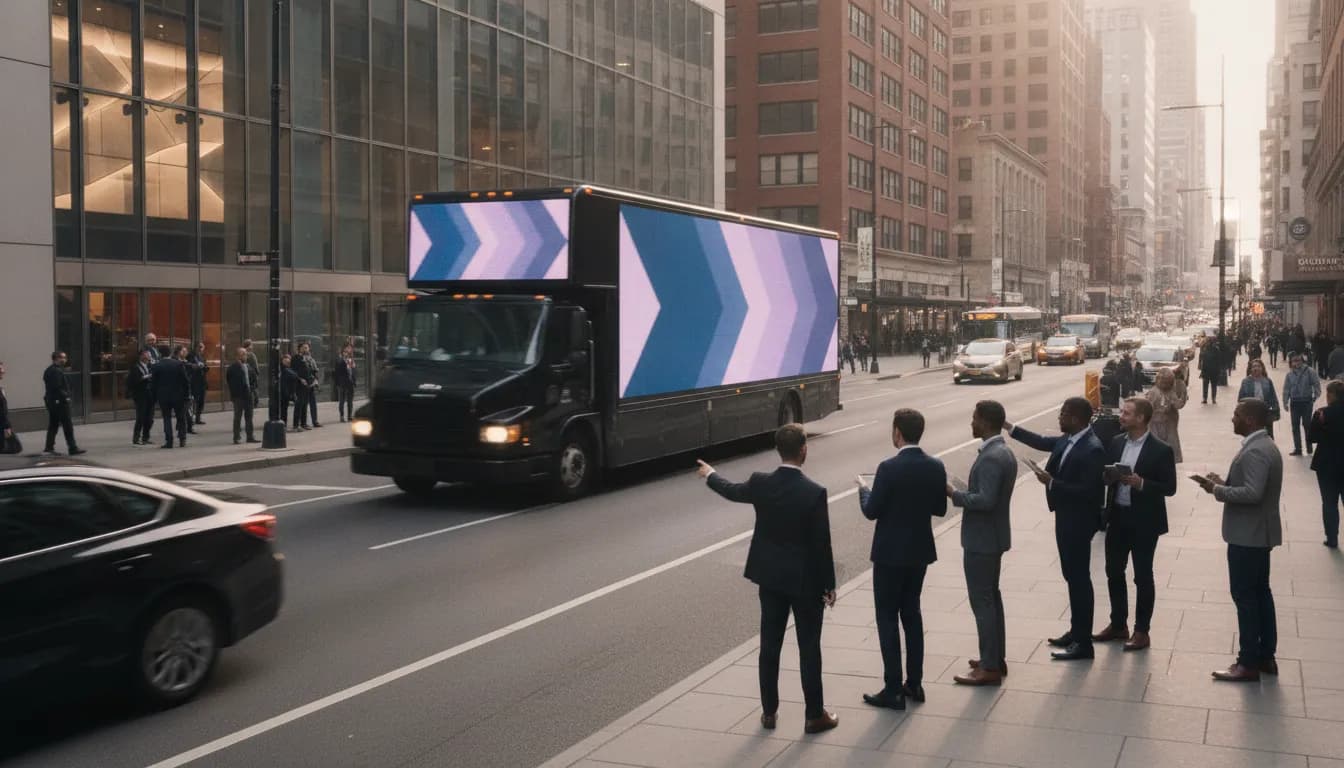
Mobile digital billboards can put a campaign in motion, but the vehicle is only one part of the media decision. The strongest programs start with a defined audience, a reason to be in specific environments, and a plan for how route, timing, creative, and reporting work together. That makes the format useful for more than adding a large screen to a media mix: it can connect a message to the places and moments a campaign is designed to reach.
Discuss a mobile campaign with All Points Media at (503) 626-0669.
Mobile digital billboard advertising uses digital screens on moving vehicles to bring flexible, audience-focused messaging into real-world locations. It can support events, launches, and geographically focused campaigns, while route strategy and execution determine whether the format fits the broader place-based plan.
Before evaluating creative or measurement, media buyers need a precise view of what the format includes. How it differs from fixed digital and static OOH, and where its mobility creates planning value.
What Is Mobile Digital Billboard Advertising, and How Does It Work?
Mobile digital billboard advertising uses a vehicle-mounted digital screen to bring a brand message through selected streets, destinations, and event areas. Unlike a static billboard, the format can be routed around a defined audience or moment. Unlike fixed digital out-of-home, it is not tied to one screen location. The route, timing, creative, and operating plan work together as one media activation.
All Points Media's AdVan Media is its mobile digital billboard offering. The proprietary mobile billboard vehicles are described as featuring dual HD screens, theater-quality sound, and interactive capabilities. Those specifications create more than a moving display, but the campaign still depends on disciplined media planning. A route should support the audience and objective, while the creative must communicate quickly in a mobile environment.
That makes the format a natural component of a broader place-based media campaign strategy. A media buyer may use a mobile unit to add physical presence around an event, concentrate activity in selected areas, or complement other out-of-home placements. The right role depends on where the audience moves and what the campaign needs the format to accomplish. Not on a universal promise that mobile is better than fixed inventory.
It is also important to separate AdVan from APM Digital powered by Impactivate. AdVan refers to the mobile billboard vehicle offering. Impactivate refers to a separate Atlantic City boardwalk digital network, with screens in a fixed physical environment. They should not be described as the same product or blended into one inventory type. For broader context, compare the format with other digital out-of-home advertising options.
Mobile digital billboard advertising puts dynamic creative on a routed vehicle, allowing a campaign to bring digital out-of-home presence into selected areas and moments. AdVan is All Points Media's mobile vehicle offering, while Impactivate is a separate fixed digital network on the Atlantic City boardwalk.
Where Mobile Digital Billboards Fit in a Place-Based Media Plan
Mobile digital billboards work best as a deliberate extension of a broader place-based media plan, not as a substitute for every fixed or static format. All Points Media can align a moving unit with audience movement. Then use fixed screens or static placements to reinforce the message in the environments where that audience spends time.
The planning question is not simply whether a format is digital. It is what the format needs to do. A mobile unit can bring a message to a defined route, event, or activation window. Fixed digital screens can provide continuity in selected venues. Static OOH can establish a durable visual presence where the placement itself is part of the environment.
| Format. | Mobility. | Planning role. | Creative consideration. |
|---|---|---|---|
| Mobile digital billboard. | Moves through selected routes or activation areas. | Adds flexibility around audience movement, events, and market priorities. | Keep the message concise, high-contrast, and legible in motion. Use motion or sound only when appropriate. |
| Fixed digital place-based screen. | Anchored to a venue or physical environment. | Builds repeated exposure within a chosen place-based network. | Design for the screen context, viewing distance, dwell time, and surrounding content. |
| Static OOH. | Fixed for the booked placement period. | Creates consistent presence along a specific location or corridor. | Use a simple visual hierarchy that remains clear across changing light and viewing conditions. |
Mobile digital billboards add movement and timing flexibility to a place-based plan. Fixed digital screens provide continuity inside selected environments, while static OOH contributes durable location-based visibility. Combining formats should follow the audience, route, venue, and campaign objective rather than a preset channel mix.
For buyers evaluating the fixed-screen layer, All Points Media's digital place-based advertising reach illustrates how digital environments can support a campaign without confusing that network with the separate AdVan mobile offering. The strongest plan gives each format a distinct job, then coordinates creative and timing so the campaign feels connected wherever the audience encounters it.
How to Plan Routes, Audiences, and Timing
Effective mobile digital billboard planning starts with the campaign objective, then maps the audience's real environments and movement patterns. From there, planners align routes and timing with market constraints, creative needs, and operational requirements. The result is a coordinated activation built around where the audience is, not simply where inventory happens to be available.
- Define the objective and decision criteria. Start by identifying what the activation must do within the broader media plan. An event marketer may need physical presence around a venue and a defined arrival window. An agency team may need a complementary out-of-home channel that adds market flexibility to an omnichannel campaign. Establish the priority market, audience behavior, timing window, call to action, and proof required before selecting routes. This keeps the plan accountable without inventing reach or outcome targets that have not been sourced.
- Map audience environments, not just demographic labels. Translate the audience into the places and occasions that matter: event approaches, retail corridors, entertainment districts, business areas, or other high-relevance environments. All Points Media builds custom advertising networks, so the planning question is which locations and movements best support the objective. Its AdVan mobile digital billboards can then be considered as one mobile component within that audience-first plan.
- Build the route and timing logic. Choose paths that connect the audience environment to the campaign moment. Schedule activity around event ingress and egress, commuting patterns, launch windows, or other verified timing considerations. Mobile formats can extend beyond a single fixed point, but that flexibility still requires a practical route, approved operating plan, and market-specific confirmation.
- Resolve market and format constraints early. Confirm where the vehicle or configuration can operate, what permissions or restrictions apply, and whether the selected market supports the intended execution. Nationwide operation does not mean every vehicle or configuration is available in every market. Historical rolling-billboard campaigns, including a University of Nebraska promotion using 53-foot semi-trailers, also show why fleet, geography, and logistics belong in the plan from the start: the execution model must match the campaign's footprint.
- Coordinate creative, production, and proof. Lock the route assumptions before finalizing creative production, installation, campaign management, and reporting. Confirm screen specifications, approvals, handoffs, and the evidence the client expects after delivery. This coordination turns a route idea into an executable campaign rather than a media concept that cannot be operationalized.
What Creative Works on a Moving Digital Billboard?
Effective mobile digital billboard advertising treats the screen as a fast, physical encounter rather than a miniature television spot. Lead with one idea, make the brand recognizable immediately, and design for viewing conditions that change with traffic, distance, and movement. Sound, interaction, and mobile follow-up can extend the experience when the setting supports them.
Motion-first creative should communicate before a viewer has time to decode a paragraph. Use a clear visual hierarchy: brand or offer first, one supporting message second, and a single action when one is necessary. Short transitions, strong contrast, large type, and a restrained color palette help the message remain legible as the vehicle moves through the market. Build the concept around the audience and route, not around every feature the screen can display.
AdVan Media is described as using proprietary mobile billboard vehicles with dual HD screens, so creative can be developed for visibility from more than one direction. The offering also includes theater-quality sound and interactive capabilities. Those elements are useful when the route, dwell time, event setting, and operating conditions make participation realistic. They should not become mandatory layers on every execution. A concise visual may be stronger than an overloaded activation.
A mobile follow-up path can turn a brief display encounter into a next step. A QR code, short URL, or other mobile prompt should lead to a page designed for immediate use, with the same message and a clear action. Research on public displays notes that smartphones can let passers-by take away content and consume it on the go. But display-to-mobile interaction depends on device binding, content selection, and transfer between devices. See the academic research on display-to-mobile interaction for that framework.
Plan the creative and follow-up together. That keeps the moving billboard focused in-market while giving interested viewers a practical way to continue the conversation after the vehicle is out of sight.
How Should Media Buyers Measure a Mobile Digital Billboard Campaign?
Measurement should be designed before the vehicle moves. Start by agreeing on what the campaign must prove, which evidence will answer that question, and where the limits of the data sit. That discipline keeps mobile digital billboard advertising accountable without turning modeled exposure into a guaranteed business outcome.
Define delivery and proof questions first
Separate operational proof from media evaluation. Delivery questions might include: Did the campaign run in the agreed market and time window? Were the planned routes, event areas, or audience environments covered? Was the approved creative displayed as scheduled? What documentation will confirm execution?
Then define the evaluation question. Is the objective broad awareness, support for an event, reinforcement near a retail location, or a measurable response to a specific call to action? The answer determines whether the useful evidence is a campaign log, route documentation, event coordination records, a brand-lift study, response data, or a combination. Do not claim a reach figure, conversion rate, or attribution result unless the methodology and source support that exact claim.
Keep exposure separate from outcomes
Impressions can be one input to an evaluation, but they are not interchangeable with unique people, attention, consideration, visits, or sales. A 2024 observational study specifically examined impressions as a media-dose metric in a tobacco public-education campaign evaluation. Which is a useful reminder that the meaning of an impression depends on how it is defined and applied: read the study on impressions and campaign evaluation.
For the outcome layer, use a measurement design that fits the activation. A dedicated landing page, campaign-specific QR code, or controlled response mechanism may help identify direct actions, while surveys or brand studies can address awareness questions. Treat those signals as evidence associated with the campaign, not automatic proof that the mobile unit caused every response.
All Points Media can align campaign management with proof-of-performance reporting, while media buyers retain a clear record of what was delivered and what remains an analytical question. For a relevant reference point, review this real-world digital OOH campaign.
Discuss a measurement-ready campaign with All Points Media at (503) 626-0669.
Set delivery and evaluation questions before launch, document what ran, and keep exposure metrics distinct from outcomes. Impressions require a defined methodology, while conversions and attribution need campaign-specific evidence. A credible report makes those distinctions visible instead of presenting modeled reach or response as guaranteed performance.
When Is Mobile Digital Billboard Advertising a Strong Fit?
Mobile digital billboard advertising is strongest when a campaign benefits from a physical presence that can move with an audience. Concentrate around an event or launch, or support a defined geographic objective. It is not a universal replacement for static OOH or fixed digital media. The right fit depends on route, timing, market conditions, creative, and the role the format plays in the wider plan.
Events and brand activations. A mobile unit can add a visible, flexible layer to an event strategy, particularly when the objective extends beyond the footprint of the venue itself. All Points Media positions its AdVan offering for brand activations and events, giving planners a way to consider movement, arrival patterns, and surrounding activity alongside the event site. The activation still needs a clear audience and operating plan; mobility alone is not a campaign objective.
Product launches and time-sensitive moments. Mobile digital billboards can be considered when a message needs to appear in selected environments during a defined window. That may include launch activity, a seasonal push, or a market-specific activation. Route planning should follow the audience and the moment, rather than treating a vehicle as a substitute for a broader media schedule.
Geographic concentration and audience movement. The format is relevant when planners need to connect multiple environments or concentrate physical presence around a priority area. All Points Media operates nationwide, but vehicle and configuration availability should be confirmed for the intended market. A strong plan identifies where the audience moves, which locations matter, and when the presence is most useful before selecting routes.
For buyers evaluating the format alongside other place-based options, review AdVan mobile digital billboards as one possible activation. All Points Media can build the recommendation around the campaign objective rather than assuming every market, audience, or brief calls for the same execution.
How All Points Media Supports the Campaign
All Points Media starts with the audience and campaign objective, then determines which environments, routes, and activation elements can support the plan. That audience-first approach matters when mobile digital billboard advertising is one part of a broader place-based media campaign. Instead of limiting the buy to a predefined unit, All Points Media builds custom advertising networks around the brief.
That process can include venue procurement, route and market coordination, and the practical decisions required to align the activation with the intended audience. All Points Media operates nationwide, but vehicle and configuration availability should be confirmed for the specific market and campaign requirements.
From concept to physical execution
Once the strategy is defined, All Points Media can manage the work needed to move from an approved idea to a live campaign. Its turnkey services include creative production, installation, and campaign management. For a mobile digital billboard, that means the creative approach, physical deployment, timing, and operational handoffs are considered together rather than treated as disconnected vendor tasks. See the company's creative production support for more context on that part of the workflow.
Campaign management also creates a clear operating point for updates, coordination, and execution questions. All Points Media's proof-of-performance reporting gives the team a basis for documenting delivery and reviewing the campaign against the original plan. It should support informed evaluation, not serve as a promise of a particular reach, response, or business outcome.
Discuss a mobile digital billboard campaign with All Points Media, or call (503) 626-0669.
All Points Media supports mobile digital billboard campaigns from audience-first strategy through custom network development, production, installation, campaign management, and proof-of-performance reporting. The goal is a coordinated execution plan tailored to the brief, market, and audience, without assuming a specific result before the campaign runs.
Frequently Asked Questions
How much does a mobile digital billboard campaign cost?
There is no single rate that fits every plan. Cost is shaped by the campaign objective, market and route requirements, campaign duration. Number and type of vehicles, creative production, activation needs, and the level of reporting or coordination required. A media buyer should scope those variables together rather than compare a mobile unit as if it were fixed inventory.
How do media buyers choose routes for a mobile digital billboard campaign?
Start with the audience and the environments where that audience spends time, then build routes and timing around the campaign objective. Consider event schedules, traffic patterns, geographic priorities, local operating constraints, and opportunities to coordinate with nearby venues or other media. Vehicle availability and configuration should be confirmed market by market.
What creative works best on a moving digital billboard?
Use motion-first creative that communicates one clear idea quickly, with strong contrast, minimal copy, and a recognizable brand cue. Build a follow-up path when the objective calls for action, such as a short URL or mobile experience. All Points Media describes its AdVan offering as using dual HD screens, with sound and interactive capabilities available for appropriate activations (AdVan Media).
When is this format a strong fit?
Mobile digital billboards can be a strong fit for launches, events, brand activations, and campaigns that need a flexible physical presence around specific audiences or places. They are not automatically the right replacement for static outdoor media or fixed digital screens. The best role depends on the audience, geography, timing, creative, and how the format supports the broader media plan.
Ready to Discuss Your Mobile Digital Billboard Campaign?
All Points Media can help connect your campaign objective with the right audience, routes, environments, and creative approach. A focused conversation is a practical next step for evaluating where mobile digital billboard advertising may complement your broader place-based media plan.