
DOOH advertising, short for digital out-of-home advertising, is marketing delivered through digital screens in public or shared environments outside the home. For media buyers, the important distinction is not simply that the ad appears on a screen. It is that the screen can be scheduled, updated, and matched to a physical place, audience context, and campaign objective. This guide explains how the channel works, where it fits, and what to evaluate before a buy. For a deeper look at how All Points Media applies digital capability to a defined place-based network, see APM Digital, Impactivate, and the future of DOOH advertising.
What Is DOOH Advertising? A Clear Definition
DOOH is a form of out-of-home media that uses digital displays to deliver visual advertising in places people visit, pass through, or spend time. Those displays may be large roadside screens, transit panels, retail displays, digital kiosks, venue screens, or LED structures in an entertainment district. The common thread is the combination of a digital display and an out-of-home audience, not the size of the screen or the software used to sell it.
The Interactive Advertising Bureau's DOOH definition describes digital media used for marketing outside the home, delivered through digital screens in public and commercial spaces. Its definition includes dynamic broadcast and interactive content, as well as targeting inputs such as venue, geography, screen ID, daypart, and schedule. That gives buyers a useful starting point: DOOH is a physical media channel with digital delivery capabilities, not mobile or online advertising shown near a public location.
What counts as DOOH?
- Digital screens in public places: Billboards, transit displays, kiosks, retail screens, and venue displays can all be DOOH inventory.
- Dynamic or scheduled creative: Messages can rotate, change by daypart, or update without replacing a printed face.
- Out-of-home exposure: The audience encounters the message away from a personal device in a shared physical environment.
- Contextual planning: The media plan can account for location, venue type, movement patterns, dwell time, and the role of the screen in the broader campaign.
A digital sign does not automatically make a campaign smart. A screen may be technically capable of dynamic delivery while still being a poor fit for the audience, creative, or objective. Strong DOOH planning starts with the environment and then determines whether digital flexibility adds value.
DOOH is also broader than programmatic DOOH. Programmatic DOOH refers to an automated buying and delivery method for eligible digital inventory. A buyer can purchase DOOH directly through a media partner, as part of a custom venue network, or through a programmatic platform. The inventory is still DOOH in each case; the transaction method changes.
DOOH advertising is out-of-home marketing delivered through digital screens in public or shared environments. It supports scheduled, dynamic, and sometimes interactive creative, with planning inputs such as venue, geography, daypart, and screen. Programmatic DOOH is an automated way to buy some DOOH inventory, not a different medium.
DOOH vs. Traditional OOH: What Makes It Digital?
The difference between DOOH and traditional OOH begins with the display medium. Traditional OOH typically uses printed posters, bulletins, wallscapes, transit shelters, or other static surfaces. DOOH uses networked digital screens. Both are physical media, both can be planned by geography, and both depend on the environment where the audience sees the message.
| Planning factor | Traditional OOH | DOOH |
|---|---|---|
| Creative change | Usually requires a new print production and posting cycle. | Can support remote content updates when the network and contract allow them. |
| Message rotation | Often maintains one creative execution for the contracted period. | Can rotate multiple messages, dayparts, or scheduled versions. |
| Context triggers | Can be planned around place and time, but the installed message remains fixed. | May support planned triggers such as time, weather, events, or live updates when available. |
| Production needs | Requires physical materials, specifications, installation, and condition checks. | Requires digital files, technical specifications, content approval, and network delivery checks. |
| Measurement | Uses the agreed audience, placement, and proof-of-performance framework. | Adds possible play logs, screen status, delivery records, and interaction signals to that framework. |
Digital does not mean that every DOOH impression is individually targeted or that every screen can change in real time. Capabilities depend on the operator, hardware, contract, content rules, and available data. Buyers should ask which features are included in the specific inventory rather than treating the label DOOH as a guarantee of targeting or optimization.
DOOH, digital signage, and retail media
Digital signage is a broad operational term for electronic displays used to show content. DOOH describes the advertising use of digital displays outside the home. Retail media may use the same physical screen, but its strategy often depends on a retailer's first-party data, shopper relationship, or sales measurement. In practice, the categories can overlap. The planning distinction is usually the audience data, commercial relationship, and measurement model behind the screen.
That distinction matters for media buyers evaluating proposals. Ask whether the buy is sold as public out-of-home media, retail media, venue media, or a combination. Then confirm the audience definition, placement environment, data inputs, creative rotation, reporting, and any restrictions. A clear operating description is more useful than a label that implies capabilities the inventory does not provide.
DOOH is digital because it uses networked screens that can support scheduled or changeable creative. Traditional OOH usually relies on a fixed physical message, but both channels share the same need for strong location, audience, and execution planning. Digital capability should be confirmed at the inventory level, not assumed from the label.
Types of DOOH Advertising: Roadside, Transit, and Place-Based
DOOH appears in many environments, and the setting changes what the audience can reasonably notice or do. A fast-moving roadside audience needs a simple, legible message. A commuter waiting in a station may have a different attention window. A person spending time in a retail, healthcare, fitness, hospitality, or entertainment venue may encounter a screen repeatedly and in a more specific context.
Roadside and large-format digital screens
Roadside digital billboards and large-format displays are designed for visibility across vehicle and pedestrian movement. Creative usually needs to communicate quickly, with a strong visual hierarchy and limited copy. Geography, traffic patterns, sightlines, speed, and the relationship between adjacent screens all matter. These placements can play a broad awareness role, especially when a campaign needs consistent presence across priority corridors.
Transit and travel environments
Transit DOOH can include displays in airports, rail stations, subway systems, bus shelters, terminals, and other travel environments. The audience may be moving, waiting, transferring, or navigating. That creates different opportunities for sequential creative, directional information, event messaging, and location-specific calls to action. Buyers should evaluate dwell patterns, sightlines, sound limitations, operating hours, and whether the environment supports a useful response path.
Retail and point-of-purchase environments
Retail screens can support product education, promotion, brand reinforcement, or a message close to a purchase decision. The plan should clarify whether the media is being sold as retail media, DOOH, or a blended program. Confirm access to retailer data, the available measurement, creative restrictions, and how screen placement relates to the shopper journey. Proximity to a product is not the same as proof that the screen caused a sale.
Place-based venue networks
Place-based DOOH uses digital screens in selected venues where a defined audience gathers. Examples may include gyms, healthcare facilities, colleges, restaurants, hotels, community centers, stadiums, and entertainment destinations. The value is not only the display. It is the connection between the message and the venue context, audience profile, dwell time, and campaign purpose.
All Points Media builds place-based media campaigns around audience and venue requirements rather than offering only a fixed list of screens. Its network spans more than 50 venue categories, allowing planners to consider digital alongside static, experiential, sponsorship, and other physical formats. Review the place-based media capabilities from All Points Media when the campaign needs venue selection and execution beyond a screen-only plan.
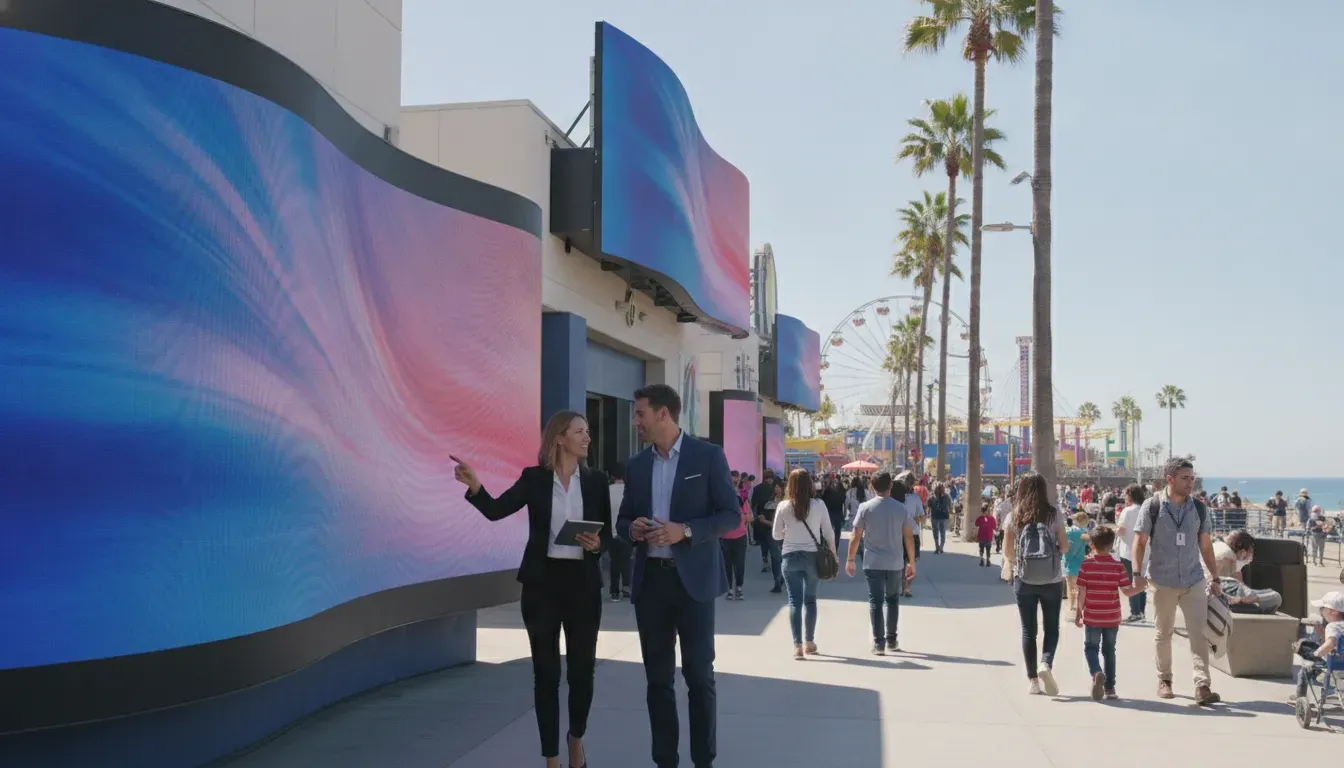
The APM Digital Powered by Impactivate network is one example of a place-based digital environment. Its Atlantic City boardwalk setting shows why buyers should assess the physical destination, audience movement, screen design, and operating features together. The broader lesson applies to other markets: the best format depends on where the audience is and what the campaign needs the environment to do.
DOOH can appear on roadside screens, in transit and travel settings, near retail decisions, or inside high-dwell place-based venues. Each environment creates different creative, audience, and measurement requirements. Media buyers should evaluate the physical setting first, then decide whether digital flexibility and screen capabilities support the campaign objective.
Why Is DOOH Growing in Media Plans?
DOOH has become more useful to media planners because it combines the physical presence of OOH with a more flexible content and delivery system. A buyer can coordinate multiple creative versions, support a timely message, or align a screen schedule with a venue, event, or daypart without producing a new printed face for every change. That flexibility can make the channel easier to integrate into a broader plan.
DOOH also fits the way many campaigns are being planned across channels. A brand may use video, social, mobile, audio, connected TV, and physical media at the same time. Digital out-of-home can reinforce the same campaign idea in the real world, while a QR code or short URL can create a handoff to a digital experience. The handoff should be useful and trackable, not added simply to make a physical placement look digital.
Flexibility without losing the physical environment
Online media can change quickly, but a digital screen remains anchored to a real place. That creates an opportunity to use timing and creative relevance while keeping the audience encounter connected to a venue, destination, or movement pattern. For example, a message can be tailored to a time of day or event schedule, while the campaign still depends on people being present in the selected environment.
That combination is especially relevant when audiences are difficult to reach through one channel alone. People move between workplaces, healthcare settings, campuses, stores, recreation venues, restaurants, and entertainment destinations. A place-based network can help a buyer plan around those routines. Digital is one execution layer within that network, not a replacement for the audience and venue strategy.
What DOOH does not solve by itself
- It does not turn an unclear audience definition into a sound media plan.
- It does not guarantee attention, engagement, conversions, or revenue.
- It does not make every screen addressable to an individual person.
- It does not replace creative designed for viewing distance, motion, and context.
- It does not eliminate the need to confirm delivery, placement, and reporting responsibilities.
Those limits are useful guardrails. A strong DOOH proposal explains what is known, what is estimated, which data is used, and how delivery will be documented. The medium can be flexible without making unsupported performance promises.
DOOH is growing in media plans because it adds content flexibility, scheduled delivery, and cross-channel coordination to a physical OOH environment. Its value still depends on audience fit, venue context, creative quality, and accountable execution. Digital flexibility is an advantage, not a substitute for strategy or proof.
How Do Media Buyers Plan and Buy DOOH Campaigns?
Media buyers can evaluate DOOH with the same discipline used for other channels, while adding questions about screen operation and the physical environment. The process should begin with the campaign problem and end with a defined delivery and measurement plan.
1. Define the audience and campaign role
Start with the audience, geography, objective, and role DOOH should play. Is the campaign intended to build awareness, support consideration, reach a local trade area, reinforce a launch, or create a response path? Decide whether the screen should provide broad visibility, repeated venue exposure, contextual relevance, or a bridge to another channel.
2. Select environments, not just impressions
Compare the environments where the audience actually spends time. Review venue type, audience profile, dwell time, frequency opportunity, dayparts, geography, sightlines, and the relationship between the screen and the surrounding activity. If the campaign needs national, regional, or local scale, ask how the network handles consistency across markets while preserving the relevance of each location.
3. Confirm inventory and technical specifications
Ask for screen dimensions, aspect ratio, resolution, file requirements, sound availability, loop length, share of voice, operating hours, content restrictions, and delivery deadlines. Confirm whether the campaign is direct-sold, programmatic, or a hybrid. Also ask which features are actually available: dayparting, dynamic creative, weather or event triggers, live content, interactive tools, or location-level scheduling.
4. Build creative for the viewing situation
Creative should match the audience's speed, distance, attention window, and environment. A short message may be appropriate for a roadside screen, while a longer-dwell venue may support more explanation or a useful interaction. Motion should aid comprehension rather than create visual noise. If audio is available, confirm that it is appropriate for the setting and does not become the sole reason the creative works.
5. Plan buying, flighting, and operations together
Document the markets, venues, screens, dates, dayparts, rotations, creative versions, approvals, trafficking responsibilities, and change process. In a custom place-based network, clarify which partner handles venue relationships, production, installation, campaign management, screen operations, and field checks. All Points Media's full-service model connects strategic venue selection, network building, production, installation, campaign management, and proof-of-performance reporting through one accountable partner.
6. Agree on measurement before launch
Set expectations for delivery evidence and outcome measurement before the campaign starts. Ask what will be reported at the screen, venue, market, or network level; which inputs are modeled; how exceptions are handled; and what the report cannot establish. If the campaign uses a QR code, landing page, store locator, or mobile extension, define the tracking method and attribution window in advance.
Planning a DOOH campaign means defining the audience and role first, selecting environments, confirming inventory capabilities, adapting creative to the viewing situation, documenting operations, and agreeing on measurement before launch. A screen list is not a complete media plan unless it explains context, delivery responsibility, and proof.
How Should Buyers Measure DOOH Campaigns?
DOOH measurement should separate delivery, audience opportunity, interaction, and business outcome. These are related but not interchangeable. A campaign may document that creative was scheduled and displayed, estimate the audience opportunity in a venue, record a QR scan, and separately measure site activity or store behavior. Each signal answers a different question.
| Evidence type | What it can help answer | What it does not prove alone |
|---|---|---|
| Placement and play records | Was the approved creative scheduled or delivered on the planned inventory? | That every viewer noticed or acted on the message. |
| Audience opportunity estimates | How many people may have been exposed based on the agreed methodology? | Unique human attention, engagement, or incremental sales. |
| Interaction signals | Did people scan, visit, submit, or use the response path? | That the DOOH placement alone caused each action. |
| Business outcomes | Did a defined outcome change during the measurement period? | That the change was caused only by DOOH without a controlled design. |
A responsible report makes the methodology visible. It identifies the source of audience estimates, describes the period and geography, distinguishes observed from modeled data, and documents any missing or exceptional placements. For a venue network, proof of performance may include placement checks, field photos, screen or unit status, delivery logs, and a final recap. The correct evidence depends on the format and the agreed scope.
Buyers should also match the measurement to the campaign objective. A brand awareness campaign may prioritize qualified reach and frequency, while a direct-response extension may use a landing page, QR code, or location action. Neither should be judged by a metric that the campaign was not designed to influence. Measurement becomes more useful when the objective, audience, creative, venue, and response path were aligned from the beginning.
DOOH measurement should distinguish delivery records, audience opportunity, interactions, and business outcomes. A play log can document delivery, but it cannot prove attention or sales by itself. Buyers should agree on methodology, evidence, limitations, and objective-specific outcomes before the campaign launches.
Frequently Asked Questions About DOOH Advertising
What does DOOH stand for?
DOOH stands for digital out-of-home advertising. It describes advertising delivered through digital screens in public or shared environments outside the home.
How does DOOH advertising work?
A buyer selects eligible digital inventory, defines the audience and campaign schedule, supplies approved creative, and coordinates delivery through a media owner, network, or programmatic platform. The campaign may use location, venue, daypart, schedule, or other contextual inputs. Reporting then documents delivery and any agreed response or outcome signals.
What is the difference between DOOH and programmatic DOOH?
DOOH is the media channel and inventory. Programmatic DOOH is an automated buying method for eligible digital out-of-home inventory. A campaign can use DOOH without being bought programmatically.
Are digital billboards DOOH?
Yes. Digital billboards are a common DOOH format when they deliver advertising on digital screens outside the home. Other formats include transit displays, kiosks, retail screens, and digital displays in place-based venues.
How much does DOOH advertising cost?
DOOH pricing varies by format, market, venue, audience, schedule, screen availability, creative requirements, and campaign scope. A useful proposal should explain what the investment includes, how inventory is selected, and which production, installation, operations, and reporting responsibilities are covered rather than presenting a number without context.
Is DOOH only for large national brands?
No. DOOH can support national, regional, local, and venue-specific campaigns when the inventory and operating model fit the objective. A local campaign may use a defined trade area or selected venues, while a national program may coordinate multiple markets through a broader network.
What should a media buyer ask a DOOH provider?
Ask where the screens are located, who the audience is, what the dwell and viewing conditions are, how creative is scheduled, whether buying is direct or programmatic, which dynamic features are available, how delivery is verified, and what the measurement methodology can and cannot establish.
DOOH is digital out-of-home advertising delivered through screens in public or shared environments. Media buyers should distinguish the channel from programmatic buying, compare formats by context, and ask providers to document inventory, creative, operations, measurement, and limitations.