
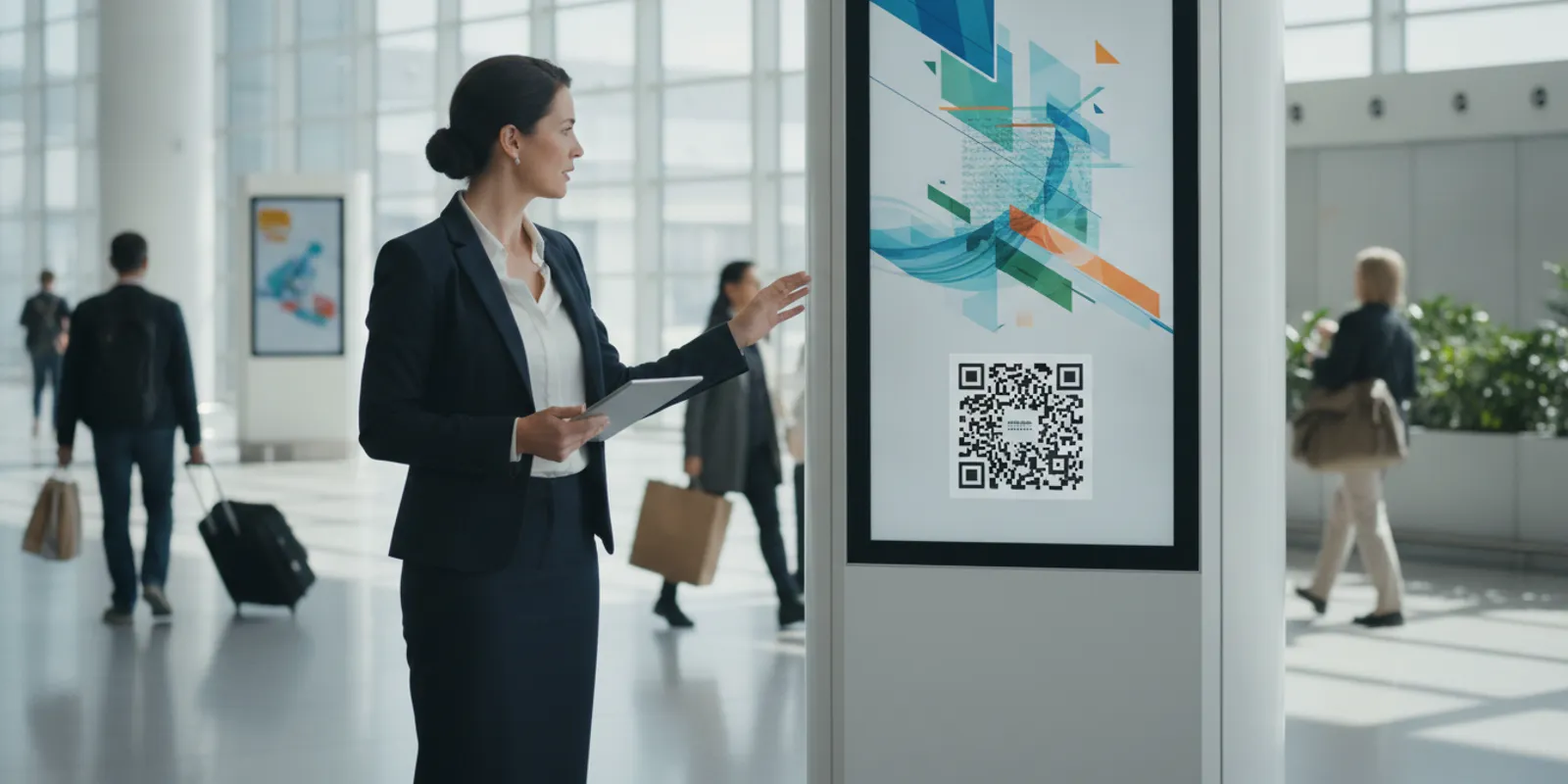
QR codes in place based advertising can give a venue impression a useful next step. A person may see a message in a pharmacy, restaurant, fitness center, library, community space, or another high-dwell environment and choose to scan for information, an offer, registration, directions, or a digital experience. For media buyers and advertising agencies, the important question is not simply whether a QR code can be placed on creative. It is whether the code helps a defined audience move from an in-venue moment to a campaign action.
Discuss a place-based campaign
What role can a QR code play in place-based advertising?
A QR code is a bridge between a physical message and a digital destination. It can make a static poster, table tent, counter card, window display, screen, or other venue placement more actionable. The code does not replace the message. It supports the message by offering a clear response for people who are interested enough to continue.
This distinction matters in place-based media. A person may encounter an ad while waiting, dining, shopping, exercising, receiving care, or participating in a community activity. The environment creates context and may provide more attention than a hurried glance at a roadside message. Still, the person must understand the offer quickly and know why scanning is worthwhile.
Research and industry history show that QR codes have long been used to connect printed advertising with interactive experiences. The University of Southern California describes this use in its overview of QR codes and interactive advertising. In a current campaign, the strongest use is practical: give the audience a relevant action that can be completed on a phone with as little friction as possible.
When are QR codes useful in venue creative?
QR codes are most useful when the audience has a reason to act and enough time or attention to do so. They are less useful when they are added only because the format is available. Before approving a code, ask what a person should receive after scanning and why that benefit belongs in this venue.
Use a code to provide more information
A venue message may need to stay concise, while the audience may want details. A QR code can lead to a page with product information, an explainer, eligibility details, a menu, a service overview, or a frequently asked questions section. This works best when the display states what is behind the code. “Learn how the program works” is more useful than “Scan here.”
Use a code to support a local action
Place-based campaigns can be close to a store, service provider, event, or community destination. A code might lead to directions, an appointment request, event registration, a nearby offer, or a location-specific page. The action should match the audience and the venue. A broad national landing page can weaken a message that otherwise feels local.
Use a code to extend a limited message
Creative space is limited on many physical placements. A QR code can connect a short headline and a strong visual to a deeper digital experience. This is helpful for public education, healthcare information, financial services, entertainment, and consumer campaigns that need more explanation than the venue format allows.
Use a code to invite participation
Some campaigns need an audience response rather than a simple impression. A code may open a survey, contest entry, coupon, registration form, interactive story, or content experience. The experience should be appropriate for the setting and should not require unnecessary personal information. If the action is too long for the moment, the audience may postpone it and never return.
How should buyers connect the code to a campaign goal?
Start with the business or communications goal, not the QR code. A scan is an intermediate event. It can show that someone chose to continue, but it does not automatically show that the campaign achieved its purpose. Define the desired outcome first, then decide whether a code is the right path.
A useful planning sequence has five questions:
- What is the audience meant to understand? Identify the single idea the person should take away from the placement.
- What should the audience do next? Choose one primary action, such as learning, registering, finding a location, requesting information, or redeeming an offer.
- Why should the person do it now? Provide a clear reason, benefit, deadline, or moment of relevance without making a claim the campaign cannot support.
- What will count as progress? Define scans, landing-page engagement, completed forms, downloads, registrations, redemptions, or another meaningful event.
- How will the team improve the campaign? Decide in advance which elements can be tested, such as venue type, call to action, destination, creative version, or placement position.
This process prevents a common mistake: treating a QR code as a measurement strategy. The code is a delivery mechanism. The measurement plan must connect the scan to the next meaningful step.
Which venue and audience conditions support scanning?
Not every impression has the same opportunity for interaction. A buyer should consider dwell time, line of sight, audience mindset, phone use, placement height, lighting, and the physical distance between the person and the creative.
High-dwell environments can give a person time to notice and consider an action. A waiting area may support an information experience. A restaurant table may support a menu, offer, or local recommendation. A fitness setting may support content that relates to a member’s goals. A library or community venue may support a registration or public information resource. These are planning examples, not guarantees. The right fit depends on the audience, the venue’s rules, and the campaign objective.
Context also shapes trust. A code beside a relevant message can feel useful. A code placed beside an unrelated message can feel intrusive or confusing. Buyers should review the full setting, not just an inventory list. Consider whether the audience is likely to have a free hand, whether phone use is natural, and whether the venue can maintain the placement for the planned campaign period.
How should a buyer choose the placement format?
The format should give the audience enough time and distance to recognize the message and position a phone. A small code on a distant display may be difficult to use. A large code with no explanation may attract attention but fail to communicate value. The right balance depends on the physical setting and viewing behavior.
| Placement situation | Potential QR role | Creative priority | Planning check |
|---|---|---|---|
| Waiting or reception area | Information, registration, or a service explainer | Clear benefit and readable instructions | Does the audience have time and a comfortable scanning position? |
| Table or counter placement | Offer, menu, local action, or interactive content | Short message and prominent call to action | Can the code be reached without disrupting the experience? |
| Retail or point-of-purchase setting | Product details, coupon, or store-related action | Immediate relevance and simple destination | Does the landing page match the location and current offer? |
| Fitness or recreation venue | Education, enrollment, or audience participation | Contextual message and mobile-friendly experience | Is phone use acceptable and is the action suitable for the moment? |
| Community or public venue | Registration, resources, or event information | Accessible language and clear next step | Are the content, permissions, and destination appropriate for the audience? |
When a campaign uses several formats, keep the core promise consistent while adapting the call to action to the setting. A code on a tabletop can invite an immediate action. A code on a wall display may need a more explicit reason to scan and a stronger visual cue.
What makes QR creative easier to use?
Good QR creative reduces decisions. The audience should be able to answer three questions quickly: What is this? Why should I scan? What will happen next?
- Give the code breathing room. Keep it visually distinct from nearby graphics and avoid crowding it with borders, patterns, or small text.
- Use a direct call to action. Explain the result, such as “See local program details,” “Get the event schedule,” or “Explore the offer.”
- Keep the headline short. The code should support a message that can be understood at a glance.
- Make the destination mobile-first. A page that is slow, difficult to read, or hard to navigate wastes the attention earned by the placement.
- Respect contrast and readability. Test the creative in the actual viewing conditions, including distance, glare, low light, and busy backgrounds.
- Do not make the code the only way to act. When appropriate, include a short web address, phone option, or other accessible path so the campaign does not exclude people who cannot scan.
Creative should also reflect the venue’s character. A message for a healthcare environment may need a calm, informative tone. A campaign in a restaurant or entertainment setting may be more immediate and promotional. The design should feel connected to the audience moment without making unsupported promises.
How should the landing page be planned?
The destination is part of the ad. A buyer should review it as carefully as the physical creative. The page should load well on a phone, repeat the promise made in the venue, and make the intended action obvious.
Match the destination to the call to action. If the creative says “Find a nearby location,” the page should make locations easy to search. If it says “Register for updates,” the form should be visible without several unnecessary steps. If it says “Learn more,” the page should provide useful information before asking for a large commitment.
Use campaign-specific destinations when the team needs to distinguish venues, markets, creative versions, or flight dates. The exact tracking method will depend on the advertiser’s analytics setup and privacy requirements. At minimum, the campaign should preserve enough source information to compare planned placements without collecting more personal data than necessary.
Set expectations before launch. Identify who owns the landing page, who approves changes, how quickly broken links will be corrected, and what happens when an offer expires. A QR code can remain visible after a campaign has ended, so the destination should be maintained for the full useful life of the placement.
How can media buyers measure performance?
Measurement should be layered. Begin with delivery and placement verification, then review scans and downstream actions. A scan count can help compare creative or venue groups, but it should be interpreted alongside exposure, audience fit, destination quality, and conversion behavior.
A practical measurement framework may include:
- Placement delivery: Confirm where the creative appeared, for how long, and whether the intended format was installed.
- Scan activity: Review scans by venue, market, time period, creative version, or campaign source when the setup supports that comparison.
- Destination engagement: Examine page loads, time spent, content views, form starts, downloads, or other actions that match the experience.
- Outcome activity: Track completed registrations, inquiries, redemptions, visits, or qualified leads when those events are part of the campaign.
- Quality and learning: Look for broken destinations, unusual drop-off, confusing instructions, venue differences, and audience feedback.
Do not compare raw scans without context. A venue with more placements, longer dwell time, or a different audience may naturally produce a different volume. Buyers should compare like with like where possible and document changes to creative, destination, flight dates, and venue mix.
Proof of performance also matters to agency clients. A campaign partner should be able to explain how placements were managed and how results were reported. All Points Media describes a turnkey model that includes venue procurement, creative production, installation, campaign management, and proof-of-performance reporting. Buyers evaluating a broader place-based advertising network can ask how QR activity will fit into that reporting process.
What should buyers test first?
Testing should answer a decision, not create extra activity. If the team does not know whether the audience understands the offer, test the call to action. If scans vary by venue, test placement position or format. If scans are healthy but completed actions are low, review the landing page and the promise made in the creative.
Useful test variables include:
- Benefit-led call to action versus generic scan language.
- Short landing page versus a deeper information page.
- Different venue categories serving the same audience objective.
- Tabletop, counter, wall, window, or screen placement where each is permitted.
- One broad destination versus market-specific destinations.
- Static creative versus a digital version with a timed message.
Change one major variable at a time when possible. Keep the rest of the campaign stable enough to learn from the result. Record the test period and confirm that both destinations work before drawing a conclusion.
How can QR codes fit into a larger place-based network?
A network can combine several venue categories to reach an audience across related moments. For example, a campaign may use one message in a pharmacy, another in a waiting area, and a follow-up experience in a community setting. The QR code can remain connected to the same campaign goal while the language and offer adapt to each environment.
Buyers should avoid adding venues simply to increase the number of placements. A smaller, well-matched network can provide clearer learning than a broad collection of unrelated locations. Define the audience, geography, timing, and action first. Then select venues that support those choices.
All Points Media offers access to venue categories that include pharmacy advertising, doctors’ office advertising, library advertising, and laundromat advertising. These examples illustrate why context should be part of the media plan. Each setting creates a different audience moment, and the QR experience should respect that moment.
For a campaign that needs production support, review the available advertising print production services as part of the planning conversation. Production, installation, and destination readiness should be coordinated rather than treated as separate tasks at the end of the process.
What compliance and privacy questions should be considered?
QR campaigns should follow the advertiser’s legal, privacy, accessibility, and venue requirements. The exact obligations vary by campaign and audience. Buyers should confirm that claims are supportable, offer terms are clear, consent practices are appropriate, and the landing page handles personal information responsibly.
Keep the experience transparent. Tell people what they will receive before they scan or submit information. Do not hide a form, subscription, download, or promotional condition behind vague language. If an offer has an expiration date or geographic restriction, show it clearly where the audience can see it.
Review accessibility as part of creative approval. A person may not be able to scan, may not have a compatible device, or may need a different way to access the information. A readable alternative path, clear language, adequate contrast, and a usable mobile page can make the campaign more inclusive.
What is a practical workflow for launching a QR campaign?
A clear workflow reduces avoidable errors and gives the agency a useful record for client review.
- Write the campaign brief. State the audience, geography, venue context, message, primary action, timing, and success measure.
- Confirm the venue fit. Review dwell time, visibility, phone-use norms, placement rules, and the physical conditions.
- Build the destination. Prepare the mobile page or experience, then check speed, navigation, forms, disclosures, and the intended completion path.
- Create the physical and digital assets. Use one clear message, a specific call to action, and a code that can be recognized at the intended distance.
- Test in realistic conditions. Scan printed and displayed versions from the expected viewing distance and with common phone cameras.
- Install and verify. Confirm that the approved creative is in the planned location and that the destination still works after launch.
- Monitor and report. Review activity, downstream actions, placement quality, and issues on an agreed schedule.
- Optimize or close responsibly. Update the experience when the evidence supports a change, and retire or redirect the destination when the placement ends.
This workflow can be managed as part of a broader place-based campaign planning request. Giving the media partner the audience, action, venue preferences, and measurement questions at the beginning makes it easier to recommend a network and a useful QR experience.
Request a campaign conversation
Frequently asked questions
Are QR codes appropriate for every place-based campaign?
No. They are a good fit when the audience has a relevant reason to continue and the environment allows enough attention or dwell time. A code added without a clear benefit can distract from the message and produce little useful action.
Should the QR code lead to the advertiser’s homepage?
Usually, a focused campaign destination is more useful than a general homepage. The destination should match the promise in the venue creative and make the desired action easy to complete on a phone.
What should a buyer measure besides scans?
Review placement delivery, destination engagement, completed actions, and the quality of the resulting response. Scans show interest in continuing, but they do not by themselves show whether the campaign met its business or communications goal.
Can one QR code be used across multiple venues?
It can, but separate campaign sources or destinations may provide better learning when the team needs to compare venue categories, markets, or creative versions. The choice should follow the measurement plan and the advertiser’s privacy requirements.
How early should QR functionality be tested?
Test before creative approval and again after installation. Check the code from the expected distance, confirm that the landing page works on common phones, and verify that the final printed or displayed version has not been altered by resizing or production.
What is the next step?
QR codes work best in place-based advertising when they connect a relevant venue moment to a clear, useful action. Define the goal first, choose the setting carefully, make the destination simple, test the experience in context, and measure what happens after the scan so the campaign can improve.