
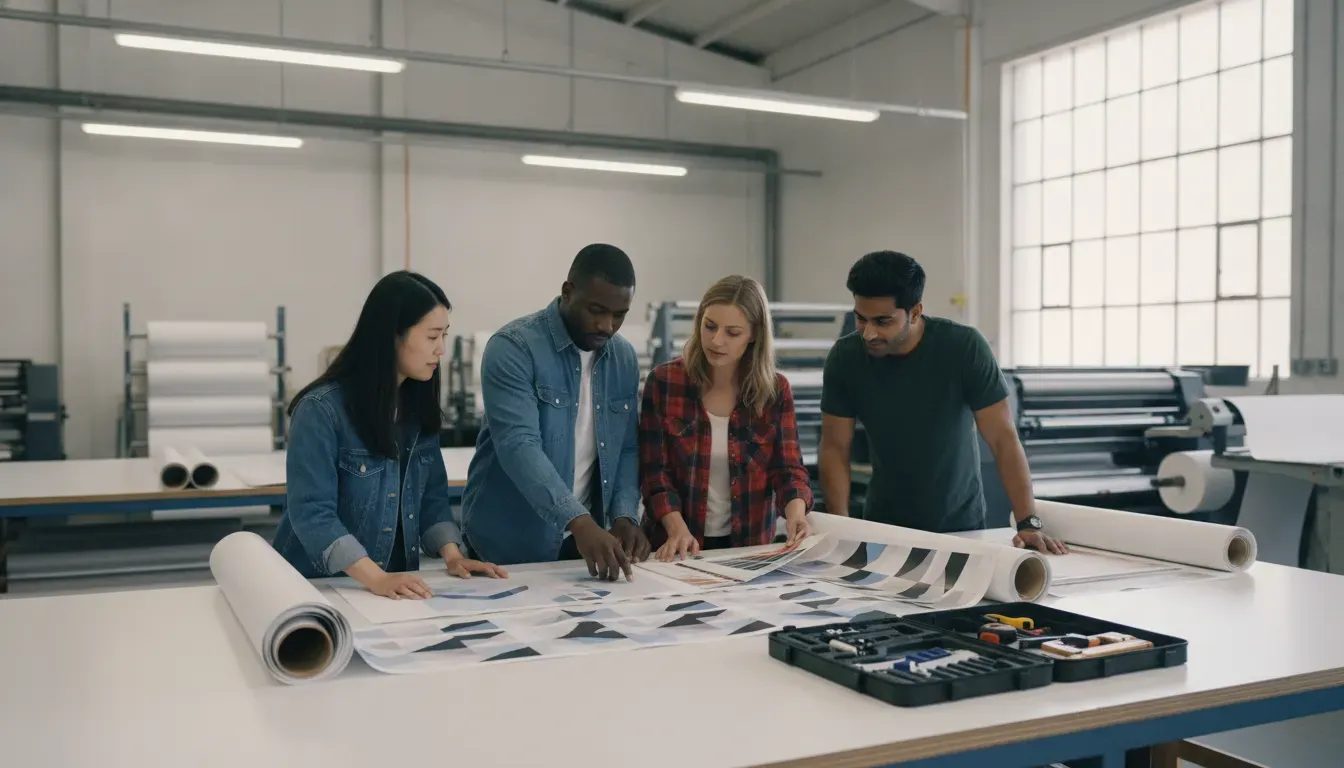
When media buyers search for ooh creative production services, they are usually solving an operational problem, not looking for another design vendor. The campaign concept may be approved, but the work still has to become venue-ready: adapted to physical formats, produced to specification, shipped to the right markets, installed correctly, and documented after launch. All Points Media connects that production work to the audience, venue, and campaign strategy behind the media plan.
What are OOH creative production services?
OOH creative production services turn an approved campaign idea into physical and digital assets that can work in real-world media environments. The scope can include production planning, format adaptation, print coordination, fabrication, quality control, shipping, installation readiness, and proof-of-performance support. It connects creative intent with the realities of each selected venue.
Out-of-home creative does not live on one standard canvas. A message may appear on a standing banner, a wall poster, a table tent, a floor decal, a screen, or another placement selected for the audience and environment. Each format changes the viewing distance, available dimensions, production materials, installation method, and amount of information a person can absorb.
That is why creative production should be considered part of the media plan. A production partner needs to understand what the campaign is trying to accomplish, who will see it, where the placement will sit, and how the audience will encounter it. The goal is not simply to reproduce a file. It is to protect the idea while making the asset effective and reliable in the physical setting.
For media buyers, this distinction is important when comparing a printer with a full-service OOH partner. A printer may produce a specified quantity. A production-services partner can help coordinate the relationship between the creative, the selected venue network, the campaign timeline, installation requirements, and delivery evidence.
Why does OOH creative need production expertise?
OOH creative needs production expertise because physical media introduces constraints that are easy to miss on a screen. Materials, dimensions, sightlines, lighting, viewing distance, venue rules, and installation conditions all affect the final result. Production expertise reduces last-minute changes and helps the approved creative remain clear, accurate, and consistent when it enters the field.
A creative file can look finished and still be unready for a national or multi-market rollout. The final check must account for:
- Format: Dimensions and proportions change from one placement type to another. A layout designed for a digital screen may need a different hierarchy for a printed banner.
- Viewing conditions: People may be moving, waiting, seated, or passing through a venue. The message needs to work at the expected distance and exposure time.
- Material selection: Paper, vinyl, fabric, rigid board, and other substrates behave differently during shipping, installation, and the campaign flight.
- Venue requirements: Operators may have rules for size, mounting, access, safety, lighting, and placement. Those requirements belong in production planning, not as a surprise after approval.
- Market variation: Regional or local campaigns may need approved versions, geographic references, or different quantities while preserving the central brand system.
Production discipline also protects the buyer's time. If media planning, design adaptation, printing, shipping, and installation are divided among vendors, the buyer becomes the project manager for every handoff. A coordinated process gives the campaign one operating plan and a clearer path for resolving exceptions.
How does the OOH creative production process work?
A dependable OOH creative production process begins with the media brief and ends with documented delivery. First align the audience and venue plan. Then translate the creative into approved formats, confirm specifications, coordinate logistics, manage installation readiness, and collect proof that the work reached the intended locations.
1. Start with the audience and venue brief
Production should begin with the same questions that shape the media plan: Who needs to be reached? In which markets? In what environments? During which campaign dates? What should the audience understand or do next? The answers establish whether the creative needs to be optimized for a quick glance, a high-dwell setting, a point-of-purchase moment, or a more immersive experience.
This step is where place-based media campaigns create a useful production context. The venue is not an afterthought. Its audience, pace, sightlines, and physical conditions help determine the appropriate format and message hierarchy.
2. Translate the concept into venue-ready formats
Next, the production team maps the approved campaign system to the actual placement mix. The brand promise, logo treatment, color relationships, imagery, legal language, and call to action should remain controlled. The layout, crop, scale, material, and information density may need to change.
Strong adaptation is not a collection of arbitrary redesigns. It is a modular system that identifies what must stay fixed and what can flex. For example, a campaign may keep the same headline and visual idea while using a shorter copy treatment for a corridor placement and a more detailed version for a waiting area.
3. Confirm specifications before production
Before materials are produced, confirm the details that determine whether the asset will work in the field. That includes final dimensions, bleed and safe areas, color requirements, substrate, finishing, quantity, packaging, delivery location, installation window, and approval owner. Digital placements require their own checks for aspect ratio, file type, resolution, playback rules, and content scheduling.
A written specification sheet gives media buyers, creative teams, production staff, venue contacts, and installers a shared reference. It also creates a practical checkpoint before the campaign moves from approved artwork to physical output.
4. Produce, inspect, and prepare for distribution
Production quality control should check more than whether a file opened. Review color and contrast, image resolution, copy accuracy, logo treatment, trim and finishing, material quality, and consistency across versions. For physical campaigns, inspect a representative sample before the full run when the format, material, or installation method warrants it.
Packaging and distribution matter as well. Materials need to be grouped, labeled, protected, and routed so the right creative reaches the right market and venue. A clean packing plan reduces confusion for installation teams and makes it easier to trace an exception if a shipment is delayed or a placement needs replacement.
5. Coordinate installation and proof of performance
Once assets are ready, production and installation should work from the same placement list and schedule. The installation plan should identify venue, location, format, quantity, access notes, escalation path, and the evidence required after the work is in place.
Proof of performance closes the loop. Depending on the campaign, documentation may include installation photographs, placement records, market status, digital playback information, or other agreed delivery evidence. This helps the media buyer distinguish between creative production, physical delivery, and campaign outcomes without treating any one of them as a substitute for the others.
What should OOH creative production include?
The right scope depends on the campaign. OOH creative production commonly includes planning, format adaptation, print or digital asset coordination, material and finishing decisions, quality control, quantity management, shipping preparation, installation coordination, and delivery documentation. Define the scope against the media plan rather than a generic production menu.
Media buyers should look for a scope that answers the practical questions below.
| Production responsibility | What to confirm |
|---|---|
| Creative adaptation | Which formats, dimensions, crops, versions, and venue-specific treatments are included? |
| Print and fabrication | Which materials, finishes, quantities, proofs, and inspection steps are part of the plan? |
| Digital preparation | Which file specifications, screen ratios, content rules, and playback checks apply? |
| Distribution | How are assets labeled, packed, shipped, tracked, and assigned to markets or venues? |
| Installation readiness | Who coordinates access, mounting, timing, safety, exceptions, and replacement needs? |
| Reporting | What documentation proves that the intended creative was delivered to the intended placement? |
The best production brief also defines approval ownership. A campaign can lose time when brand, legal, media, venue, and operations teams review the same asset at different moments without a clear decision path. Establishing who approves the master creative, adaptations, proof, and final production sample helps keep the launch moving.
For campaigns that involve many locations, the production scope should also account for change control. A revised phone number, destination URL, market reference, or required disclaimer can affect files already in production. A controlled versioning process helps prevent old creative from reaching a venue after the approved version has changed.
How can a production partner support a national OOH campaign?
A national production partner supports consistency by connecting one campaign system to many markets, venue categories, formats, quantities, and installation schedules. The partner should preserve the approved brand standard while adapting assets to local conditions, coordinating distribution, and reporting what was produced and delivered. Scale requires process, not just more vendors.
National OOH is not one oversized local order. It may involve different venue categories, production quantities, market priorities, materials, delivery windows, and installation conditions. The production partner needs a repeatable method for managing those variations without forcing the media buyer to coordinate each one separately.
All Points Media positions production within a broader turnkey model that includes strategic venue selection, custom network building, creative production through APM PrintWorks, nationwide installation through AP Installations, campaign management, and proof-of-performance reporting. That continuity is useful when a buyer needs the production plan to reflect the actual network rather than a hypothetical list of placements.
It also creates a more direct feedback loop. If a format is difficult to install or a material is not holding up in a venue, those observations can inform the next production run and campaign brief. The same is true when a message is too dense for the viewing condition. The goal is controlled adaptation, not blind standardization.
Buyers evaluating scale can browse venue networks to understand the variety of real-world environments that may affect production decisions. The right creative system should be broad enough to support that variety while disciplined enough to keep the campaign recognizable.
How should buyers evaluate OOH creative production services?
Evaluate OOH creative production services by asking how the partner handles the full path from brief to installed placement. Review production capabilities, format expertise, quality control, vendor and venue coordination, national or regional coverage, proof of performance, change management, and accountability. The strongest fit is operationally clear and aligned to the media strategy.
Before selecting a production partner, ask:
- Can the partner explain how the selected venues affect format, materials, viewing distance, and production requirements?
- Which parts of the work are handled directly, and which are coordinated through outside vendors or local teams?
- How does the partner manage creative adaptations while protecting the master brand system?
- What quality-control steps happen before the full quantity is produced?
- How are materials labeled, shipped, tracked, and matched to the placement list?
- Who owns installation coordination and exception management across markets?
- What proof-of-performance documentation will be supplied, and when?
- How are revisions handled after creative approval but before production or installation?
Ask for a sample workflow, not just a capability list. A clear answer should show the handoffs, decision owners, approval points, and evidence produced at each stage. It should also make clear what the partner can verify and what remains a campaign outcome that needs its own measurement design.
A production conversation is especially valuable when the campaign involves multiple venue types or markets. The earlier the production team sees the audience strategy and placement plan, the more useful its recommendations can be. That can prevent a late discovery that the concept needs a different crop, material, installation method, or production schedule.
For buyers who need the media and operations to stay connected, All Points Media's production and installation solution provides a direct starting point. The scope can then be shaped around audience, geography, timing, venue mix, and campaign objectives.
Frequently asked questions about OOH creative production services
OOH creative production services are most effective when they are scoped early, connected to the venue plan, and measured through clear delivery documentation. Buyers should confirm format adaptation, materials, quality control, distribution, installation, revisions, and reporting before approval. The right partner helps turn a media concept into a reliable physical-world experience.
What is the difference between OOH creative production and graphic design?
Graphic design creates the visual concept and communication system. OOH creative production prepares that system for the materials, dimensions, formats, venues, production methods, and installation conditions where the audience will encounter it. The two functions can overlap, but production adds the operational and physical requirements needed for the work to ship and perform as intended.
Can OOH creative production services support static and digital formats?
Yes. A campaign may use printed materials, fabricated displays, digital screen assets, or a combination of formats. The requirements differ by placement, so the production brief should define the correct dimensions, file specifications, material, finishing, content rules, and quality checks for each part of the campaign.
Should production be planned before venue selection?
Production and venue selection should inform each other. A venue strategy determines the available formats and physical conditions, while production requirements can affect which placements are practical. Coordinating both early helps the team choose a network that supports the creative idea instead of approving an idea that cannot be delivered consistently.
How does a full-service partner make OOH production easier?
A full-service partner can connect audience strategy, venue selection, production, installation, campaign management, and reporting under one operating plan. That reduces fragmented handoffs and gives the media buyer a clearer owner for approvals, logistics, issues, and delivery documentation. It does not remove the need for client approvals, but it simplifies coordination.
What should be included in a production estimate?
A production estimate should clarify the included formats, quantities, materials, finishing, proofs, adaptation work, packaging, shipping, installation coordination, replacement process, and reporting deliverables. It should also identify assumptions and items that depend on final venue requirements. If the estimate does not explain the work behind the number, ask for a more detailed scope.