
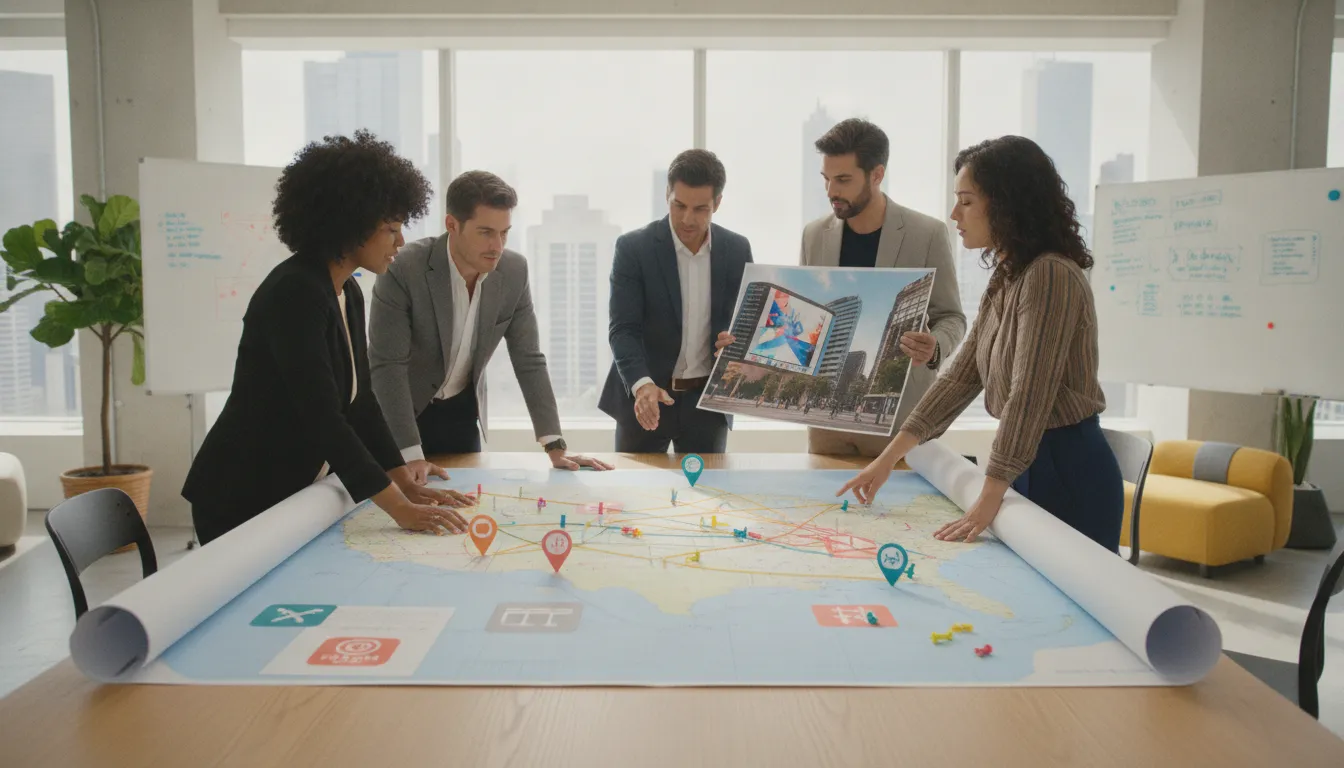
National alternative out-of-home campaigns rarely fail because a brand lacks creative ambition. They strain when venue selection, market coverage, production, installation, and verification are managed as disconnected tasks. A scalable plan must preserve a consistent brand experience while adapting to the realities of each location.
Effective national ooh campaign execution combines centralized planning with localized venue expertise. So a campaign can move consistently across more than 100,000 active venues in 50+ categories while reaching audiences in high-dwell environments. All Points Media supports this model through place-based media campaigns that connect network strategy, production, installation, and proof of performance.
That operational foundation changes how media buyers evaluate national reach. Instead of treating every market as a separate activation, teams can build a coordinated venue network. Define the right standards, and make informed adjustments without losing control of the campaign. The first step is understanding which planning disciplines make that scale manageable.
How to Scale National OOH Campaign Execution Across a Multi-Market Venue Network
Answer: Effective national OOH campaign execution depends on treating a venue network as an operating system, not a collection of isolated placements. Brands need a consistent strategy, market-level planning, adaptable creative, coordinated installation, and one accountable reporting process. That structure makes broad reach manageable without losing local relevance or executional control.
Start with the audience and the environments where that audience spends meaningful time. All Points Media can plan across more than 100,000 active venues in over 50 venue categories nationwide, creating options beyond a conventional billboard schedule. The opportunity is not simply to add locations. It is to build a network that matches campaign objectives to context, geography, audience behavior, and available inventory.
That planning process should divide the campaign into clear market and venue priorities. A national brand may need broad coverage in major metros, concentrated presence near retail locations, or a custom mix of environments that supports a product launch. Establishing those priorities before production begins helps teams standardize what should remain consistent, while preserving flexibility where local conditions require a different format, placement, or message.
Venue context also affects how the campaign earns attention. High-dwell environments can offer typical visit times of 60 to 240 minutes. Giving audiences more opportunity to encounter a message than they may have during a brief roadside impression. The creative and placement plan should use that time thoughtfully, with messaging that is easy to recognize, relevant to the setting, and repeated consistently across the network.
Execution becomes more reliable when one partner manages the connections between venue selection, production, installation, and campaign oversight. A turnkey model reduces the handoffs that can create inconsistencies between markets. It also gives media buyers a defined process for approvals, issue resolution, and final documentation rather than requiring separate coordination with every local operator.
For a closer look at how place-based media campaigns extend reach through real-world environments, review the broader planning approach. Teams building a multi-market program can also benefit from mastering national OOH campaign execution, particularly when timelines, materials, and installation requirements vary by market.
The strongest national programs establish a repeatable framework first, then apply local intelligence within that framework. That balance allows a brand to appear cohesive wherever the campaign runs while still making each venue network feel intentional rather than mass-produced.
What Makes a Venue Network Different From Standard Billboard Buying
Standard billboard buying places a message along a road and relies on passing audiences to notice it during a brief travel window. That model can be effective for broad visibility, but it is built around movement. A venue network creates a different media environment: the audience arrives at a location. Remains there, and encounters the message while engaged in an activity or waiting for the next one.
That distinction matters when a campaign needs more than roadside awareness. Place-based media campaigns can put a brand inside the daily settings where consumers spend meaningful time, including retail, fitness, entertainment, hospitality, and other high-dwell venues. Depending on the environment, audiences may spend 60 to 240 minutes at a location, creating more opportunities for repeated exposure than a single drive-by impression. This extended dwell-time range is documented in All Points Media's campaign materials.
From one roadside unit to a connected venue network
A billboard plan is often organized around individual structures, traffic patterns, and market-level inventory. A venue network is organized around audience context and coverage. All Points Media operates more than 100,000 actively leased venue locations across over 50 categories throughout the United States. That scale allows media buyers to build a coordinated footprint around where a target audience works, shops. Exercises, travels, or spends leisure time, rather than limiting the plan to one corridor or commuter route.
The difference is not simply the number of placements. It is the ability to select environments that reinforce the campaign objective. A healthcare message may need a different setting from a consumer packaged goods launch. A national brand may require consistent creative standards while still adapting the placement mix by market. Venue selection becomes part of the strategy, not just an inventory transaction.
Why context changes the buying decision
High-dwell placement also creates room for a message to work within its surroundings. A consumer may see it while waiting, walking through a facility, or returning to a familiar location. That does not guarantee performance, and visibility still depends on placement quality, audience flow, and creative execution. It does give planners more control over the circumstances in which an impression occurs.
For media buyers evaluating place-based media campaigns, the practical advantage is a broader definition of reach. Instead of choosing only where people pass, All Points Media can help identify where audiences spend time and assemble those venues into a coordinated national plan. The result is an alternative to standard billboard buying that combines geographic scale with environments selected for attention, relevance, and dwell.
| Consideration. | Traditional billboard buying. | Venue network place-based media. |
|---|---|---|
| Primary exposure. | Passing roadside traffic. | Captive, high-dwell audiences in set locations. |
| Time in environment. | Brief drive-by impressions. | Reported dwell of roughly 60 to 240 minutes. |
| Audience context. | Traffic corridors and routes. | Venues matched to an audience's daily activity. |
| Network structure. | Individual structures and local inventory. | A coordinated national footprint across 50+ categories. |
| Planning emphasis. | Placement and traffic volume. | Venue selection and campaign context. |
5 Steps to a Successful National Place-Based Campaign
National place-based media campaigns succeed when strategy, network design, operations, and measurement are treated as one connected system. The sequence below gives media buyers a practical path from the first planning conversation to a campaign that is live, documented, and ready to improve.
- Set the strategy and define the goals.
Start by clarifying the audience, priority markets, campaign dates, budget parameters, and the action the media should support. Establish the role of place-based inventory within the broader media plan, then define the indicators that will determine whether execution is on track. A clear brief prevents market selection and creative production from moving in different directions. - Choose the right venues and markets.
Translate the audience strategy into a venue and geographic plan. Consider where the target audience spends time, how long people remain in each environment, and which markets require the greatest reach or frequency. The strongest plan is not simply the largest footprint. It is a deliberate combination of locations that supports the campaign objective while leaving room for local relevance. - Build the network.
Once markets and venue types are established, assemble the inventory into a cohesive national network. This is where availability, placement standards, audience fit, timing, and market coverage must be reconciled. A custom network can preserve a consistent national strategy while accounting for the realities of individual venues. For buyers evaluating the benefits of a full-service agency, network building is a meaningful distinction: the agency should manage the connective work, not just present a list of placements. - Produce and install the campaign.
Creative production must be coordinated with the specifications and schedules of every selected venue category. Confirm final assets, quantities, shipping details, installation windows, and escalation contacts before materials move into the field. In a vertically integrated turnkey model, the same partner can manage venue selection and procurement through production and installation. That continuity reduces handoff risk and creates clearer accountability when a national rollout includes many markets and placement types. - Report results and optimize the next phase.
Execution does not end when the campaign is installed. Establish a reporting cadence that gives the media team visibility into market status, installation completion, documentation, and any issues requiring attention. Review performance and operational findings together, then use them to refine venue mix, market weighting, creative, or timing in the next wave. A disciplined feedback loop turns a one-time placement plan into a more informed national program.
The advantage of this approach is operational clarity. Each stage has a defined decision, an accountable owner, and a clear handoff to the next stage. Which helps national campaigns move from planning to live delivery without losing strategic intent.
How to Keep Creative Consistent (And Adaptable) Across 50+ Venue Categories
National campaigns need a recognizable brand system, but they should not force identical creative into every physical environment. A message that works on a gym locker-room display may need a different proportion, viewing distance. Or call to action when it appears in a hotel, airport, grocery store, or sports facility. The goal is not uniformity for its own sake. It is disciplined consistency that remains effective in context.
Define the elements that cannot change
Start with a core creative framework that governs every market and venue category. That framework should establish the campaign promise, brand voice, approved imagery, color relationships, logo treatment, offer language, and required legal or contact details. It should also identify the hierarchy of information: what a person should notice first, understand second, and do next.
These rules give a national OOH campaign execution program a dependable center. Local teams, production partners, and venue managers can adapt the format without changing what the campaign means. They should not need to reinterpret the brand every time a placement enters a new market.
Adapt the format to the venue experience
Consistency becomes more valuable when the layout responds to how people encounter the message. Consider dwell time, sightlines, ambient distractions, expected viewing distance, and whether the audience is moving, waiting, seated, or participating in an activity. A concise headline and strong visual may be appropriate in a high-traffic corridor. A more detailed message can work where people spend longer periods in place.
Visibility also depends on the surrounding environment. Research indexed by PubMed notes that heavy pedestrian volume can obscure the visibility of a physical advertising prompt, which makes placement and visual simplicity important planning considerations. Creative review should therefore evaluate the real setting, not only a flat proof.
Use modular creative for localized relevance
A modular system allows national marketers to preserve the campaign's central idea while tailoring selected components. Approved modules might include market references, venue-specific imagery, audience language, seasonal details, or a localized offer. Each variation should pass the same brand and production checks before release.
This approach supports building a hyperlocal campaign without creating dozens of unrelated executions. The strongest programs define which elements are fixed, which are flexible, and who approves each variation. All Points Media can then coordinate those decisions across a broad venue network. Keeping localized creative recognizable as part of one national campaign rather than a collection of disconnected placements.
Production and Installation Logistics at National Scale
National campaigns become difficult when production, shipping, venue coordination, and installation are treated as separate workstreams. A creative file may be approved centrally, but the campaign still has to reach the right locations, meet each venue's requirements, and appear correctly across multiple markets. Without clear ownership, brands can end up coordinating printers, local installers, venue contacts, and reporting vendors that do not share the same timeline or accountability.
All Points Media uses a vertically integrated model to manage the campaign lifecycle from venue selection and procurement through nationwide installation and proof-of-performance reporting. That structure gives a brand one accountable partner for the operational details behind its place-based media campaigns, rather than a patchwork of disconnected vendors. The approach is especially valuable when a campaign spans diverse environments, formats, and regional schedules.
One operating plan from approved creative to live placement
Turnkey execution starts before materials are produced. Venue requirements, placement specifications, quantities, delivery windows, and installation conditions must align with the network plan. Resolving those details early helps the production process reflect the actual campaign footprint instead of forcing creative or materials into locations that cannot support them.
Once specifications are confirmed, a single operating plan can coordinate procurement and production with the installation schedule. That matters at national scale because a delay in one part of the supply chain can affect market launches, venue relationships, and the consistency of the broader campaign. Centralized coordination also makes it easier to identify exceptions, adjust delivery plans, and keep stakeholders informed without asking the brand team to manage every local handoff.
This is the practical distinction between buying inventory and managing mastering national OOH campaign execution. The latter includes the operational systems that move a campaign from strategy to physical presence, with responsibilities defined across the full lifecycle.
National consistency with local execution control
A unified partner does not mean every venue is handled identically. Different categories and locations may require different materials, installation methods, or scheduling decisions. The goal is to preserve the campaign's strategic and visual consistency while adapting the implementation to each environment. That balance is easier to maintain when production and installation are managed within the same framework.
For brands with specialized requirements, bespoke OOH advertising solutions can provide a more deliberate route than forcing one standard package across every market. All Points Media can align the network build, material requirements. And installation logistics around the campaign's audience and venue strategy, while keeping the brand team out of day-to-day vendor coordination.
The result is not simply broader distribution. It is a more controlled path from approved plan to installed media. With one partner responsible for making national execution work in the real environments where audiences spend time.
Unified Reporting and Proof of Performance Across Every Market
A national OOH campaign is only as accountable as its reporting layer. When placements span cities, venue types, operators, and installation schedules, a brand needs more than a list of locations. It needs a consistent record of what was placed, where it appeared, when it was verified, and whether the execution matched the approved plan. Unified reporting turns a distributed campaign into one operational view.
All Points Media closes that loop by documenting 100% of placement photos and conducting bi-weekly integrity checks. This process creates a recurring verification trail across markets instead of relying on occasional spot checks or self-reported completion. Photo documentation can help national marketers confirm that creative was installed in the intended environment. While integrity checks provide an opportunity to identify missing, damaged, moved, or otherwise noncompliant placements during the campaign window.
One reporting standard for every market
Consistency matters as much as volume. A campaign may perform across dozens of markets, but inconsistent reporting makes it difficult to compare delivery or identify where execution needs attention. A unified structure gives stakeholders a common basis for reviewing placement status, market coverage, installation evidence, and follow-up actions. That is especially valuable when a national brand has internal teams, agencies, and regional partners all reviewing the same campaign.
Aggregated reporting also helps connect execution decisions to budget decisions. If one market requires a creative replacement, a venue adjustment, or additional verification. The issue can be surfaced within the broader campaign view rather than discovered after the campaign has ended. Media buyers can then direct attention and spend toward the markets, venue environments, or placement configurations that best support the approved strategy, without losing sight of national consistency.
Accountability without a fragmented vendor chain
Proof of performance is strongest when the same partner responsible for planning and placement also owns verification. All Points Media provides a vertically integrated model that manages the campaign lifecycle from venue selection and procurement through installation and proof-of-performance reporting. That reduces the gaps that can appear when planning, field execution, and reporting sit with separate vendors.
For national marketers, the benefit is not simply a more polished report. It is a clearer line of accountability from approved plan to documented execution. A full-service agency reporting approach gives every market a place in the same measurement conversation, helping teams verify delivery, respond to exceptions, and make more informed decisions as the campaign develops.
Frequently Asked Questions
How do you scale a national place-based OOH campaign?
Start with a network plan that aligns venue categories, markets, audience priorities, creative specifications, production, installation, and reporting. A vertically integrated partner can coordinate the full lifecycle from venue selection and procurement through nationwide installation and proof-of-performance reporting. All Points Media operates more than 100,000 actively leased venues across 50+ categories nationwide, supporting broad reach without treating every market as identical. Source.
What are the benefits of venue-based advertising networks?
Venue networks place messages in environments where audiences spend meaningful time, including locations with reported dwell times of 60 to 240 minutes. They also allow media buyers to build a campaign around relevant venue categories and local market objectives instead of relying on one standardized billboard footprint. Source.
How do you ensure proof-of-performance for national OOH?
Define documentation requirements before installation, then collect placement evidence consistently across markets. A reliable process should include complete photo documentation, placement-level records, and recurring integrity checks. All Points Media reports 100% photo documentation and bi-weekly integrity checks for campaign placements. Source.
Why use place-based media over traditional billboards?
Place-based media can complement traditional billboards by reaching audiences inside relevant, high-dwell environments and by supporting more specific venue and market selection. The strongest choice depends on campaign objectives, audience behavior, creative format, and visibility at each location. Placement planning should account for pedestrian volume, which can affect how clearly a physical message is seen. Source.
Schedule a Consultation for Your National Campaign
Call All Points Media at (503) 626-0669 to start executing your national place-based campaign today.