
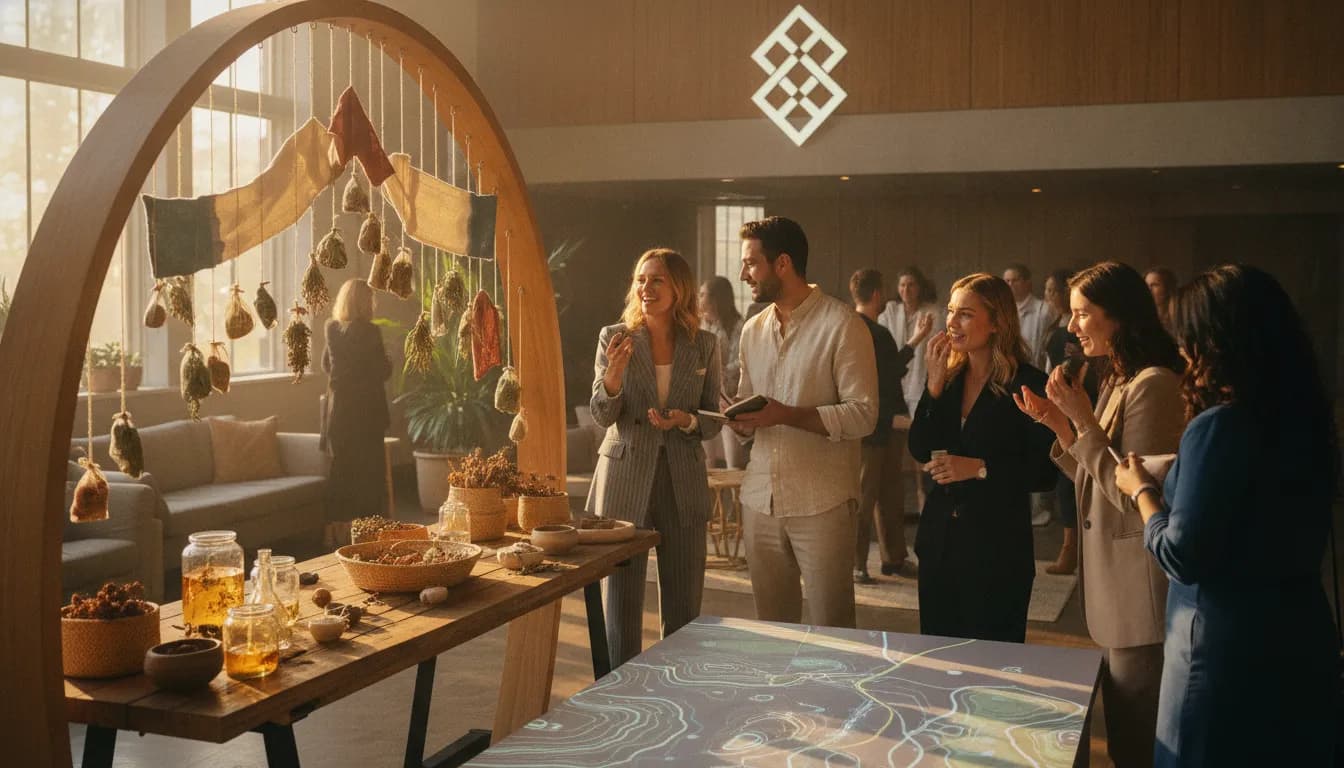
People do not experience a brand in a media plan. They encounter it while shopping, commuting, exercising, waiting for care, or spending time with a community. That is why the strongest place-based campaigns begin with a question more useful than "Where can we place a message?" They ask which environments naturally fit the audience. Behavior, and campaign objective.
Experiential marketing services connect brand strategy with real-world environments and coordinated execution. The scope may include audience and market discovery, venue procurement, creative production, installation, activation support, campaign management, and proof-of-performance reporting. The right mix depends on the brief, not a preset format.
For media buyers and brand teams, evaluating this category means looking beyond a one-time event or attention-grabbing installation. It means understanding how a partner turns an audience insight into a practical network of places, formats, and delivery standards. The distinction becomes clearer when defining what these services actually include.
What Are Experiential Marketing Services?
Experiential marketing services help a brand design and deliver meaningful interactions with people in real-world environments. Rather than relying only on functional product claims, the approach emphasizes the feelings and experiences associated with a product or brand. That can include the setting, the physical presentation, the timing, the audience interaction, and the way the experience connects to a broader campaign.
Research from Columbia Business School describes brand experience across sensory, affective, intellectual, and behavioral dimensions. It also identifies environments as one source of brand-related stimuli, alongside design, packaging, and communications. In practical terms, an experiential program should consider more than what an audience sees. It should account for where people are, what they are doing, how much attention the setting allows, and what form of interaction is appropriate. The Columbia research on brand experience provides useful academic context, but it does not establish a guaranteed campaign result.
That distinction matters when separating experiential marketing services from one-off event production. An event producer may be engaged to organize a particular launch, festival, conference, or pop-up. Experiential marketing services can include that kind of activation, but the service category is broader and more strategic. It connects audience definition, behavior, environment, creative, logistics, and documentation into a coordinated campaign plan.
For All Points Media, that planning often means placing a brand in environments where its audience is already present. Such as gyms, medical waiting rooms, restaurants, golf courses, or community centers. The company builds custom networks around audience, geography, and campaign objectives instead of limiting a plan to predetermined locations. The execution may involve venue procurement, production, installation, campaign management, and proof-of-performance reporting.
In other words, the service is not simply buying an event presence or producing a branded object. It is designing a relevant brand experience and managing the conditions that allow it to appear consistently across selected environments. Buyers evaluating experiential marketing services should ask how strategy, venue fit, execution, and reporting work together, while treating outcomes as objectives to measure rather than promises to assume.
Answer capsule: Experiential marketing services combine audience strategy, real-world environments, creative execution, activation, and campaign management. Unlike one-off event production, they connect the experience to broader marketing objectives and can extend across a custom network of venues. Strong programs define the intended interaction and measurement plan without guaranteeing a specific business outcome.
What Do Experiential Marketing Services Include?
For All Points Media, experiential campaign execution begins before a format is selected. The planning team first considers the audience, the behaviors and routines that bring people into contact with a brand. The environments that fit those behaviors, and the campaign objective. That process helps determine whether the right solution is a place-based display, a mobile activation, a staffed interaction, or a combination of elements.
Venue strategy is therefore a core service, not an afterthought. All Points Media builds custom advertising networks around the audience, geography, and objectives instead of offering only a predetermined list of locations. If an appropriate venue is not already part of available inventory, the team can seek and negotiate it. The resulting plan may support a national rollout, regional coverage, or a tightly defined local audience.
Creative planning translates that strategy into an experience people can encounter in the real world. Depending on the brief, the service stack may include creative adaptation, custom-printed visuals, digital content, sound, or a physical interaction. The goal is not to add technology for its own sake. Each element should support the way people encounter the message and the action the campaign is designed to prompt.
Execution options remain modular. A campaign may use trained staff or brand ambassadors to facilitate conversation. Product sampling to create a more tangible introduction, or mobile units to bring the experience to selected areas and events. An AdVan campaign can be tailored for national, regional, or hyperlocal audiences. Available components can include HD video screens, sound, custom exterior graphics, social interaction, gaming, or custom-developed content. None of these is mandatory for every brief.
This flexibility also allows a campaign to combine physical and digital touchpoints. A mobile unit might carry a product demonstration and sampling program, while fixed signage reinforces the message in venues where the audience already spends time. The service team coordinates the practical details across those touchpoints, including venue procurement, production, installation, logistics, campaign management, and proof-of-performance reporting. Buyers evaluating campaign production and installation should ask how those pieces connect to the audience and venue strategy rather than reviewing them as isolated deliverables.
The strongest experiential marketing services are integrated but not inflexible. They give planners one accountable operating model while preserving room to choose the formats, staffing level, creative treatment, and geographic scale that the campaign actually requires.
Answer capsule: Experiential marketing services can include audience discovery, custom venue strategy, creative development, production, installation, staffing, sampling, mobile media, digital or interactive elements, campaign management, and reporting. The right mix depends on the audience, environment, objective, geography, and level of participation required.
| Campaign need | Possible service component | Buyer question |
|---|---|---|
| Reach a defined audience | Audience and venue strategy | Does the environment match the audience behavior? |
| Create physical participation | Sampling, ambassadors, or interactive media | What action should the experience invite? |
| Deliver consistently across markets | Production, installation, and logistics | Who owns field execution and quality control? |
| Document delivery | Campaign management and proof of performance | What evidence will appear in the recap? |
How Do You Choose Environments for an Experiential Campaign?
Answer capsule: Choose environments by tracing the audience from behavior to context, then matching that context to an activation that feels useful and credible. A strong plan can combine national scale with regional, local, neighborhood, or trade-area precision, using venue relevance and execution practicality rather than assumed demographic habits.
Start with the audience behavior that matters to the campaign. Are people researching a healthcare decision, commuting, exercising, shopping for a routine purchase, waiting for an appointment, or gathering for a community activity? The behavior provides a more useful planning signal than a broad label such as "parents" or "Millennials." It shows what people are doing. How much attention the environment may allow, and which kind of brand interaction could make sense.
Next, identify environments where that behavior naturally occurs. All Points Media places brands in settings where audiences are already present, including gyms, medical waiting rooms, restaurants, golf courses, and community centers. The broader venue mix includes fitness, healthcare, retail, recreation, salons, sports, college, and other community settings. These are not interchangeable boxes on an inventory sheet. Each environment carries a different pace, level of dwell, social context, and permission structure for the message.
Then connect the environment to the activation. A static display may fit a repeated, reminder-oriented message in a high-frequency setting. A sampling program may be more appropriate where people can pause and try something. A staffed interaction, mobile unit, or digital component may support a launch or a more participatory idea, but none should be treated as mandatory. The format should serve the behavior and objective, not compensate for an unclear strategy. Campaign plans can also use varied media-format signage in specified locations for a defined period, with the placement and duration selected around the audience and setting.
Match the geographic layer to the brief
Geography should be selected with the same discipline. A national campaign may require a consistent venue strategy across all 50 states and 210 media markets, while a regional plan can concentrate investment around selected markets. Local, neighborhood, ZIP-code, or trade-area planning can bring the work closer to a store, facility, service territory, event, or community objective. AdVan campaigns, for example, can be tailored for national, regional, or hyperlocal audiences, including multiple units for regional coverage.
The final test is whether the network can be built around the actual brief. All Points Media describes its approach as creating custom advertising networks around audience, geography, and campaign objectives rather than selling a predetermined list of locations. Reviewing custom place-based venue networks helps buyers think in terms of a connected venue strategy, not isolated placements. The result should make clear why each environment belongs, what behavior it supports, and how the activation will be delivered consistently across the chosen market.
Which Experiential Formats Can Brands Use?
Answer capsule: Experiential campaigns can combine mobile media, physical signage, video, sound, ambassadors, sampling, social interaction, gaming, and custom creative. The right mix depends on the audience's behavior, the environment, the campaign objective, and the level of participation the brand wants to invite. These components are modular, not mandatory.
Format selection should follow the audience into the environment rather than begin with a predetermined technology stack. A mobile unit may be useful when a launch needs geographic movement or event proximity. A venue-based display may be stronger when the audience already spends meaningful dwell time in a fitness center, healthcare setting, restaurant, or community location. The creative and activation layer should then make that contact relevant to the moment.
For campaigns that need mobility, an AdVan can function as a mobile billboard supporting product launches, experiential events, and audience engagement. All Points Media manages planning, production, and logistics for custom AdVan campaigns, which can be tailored for national, regional, or hyperlocal reach. That makes the format adaptable to a broad tour, a cluster of markets, or a tightly defined trade area.
The vehicle itself can carry several possible components. Daylight-readable HD video screens can deliver motion and demonstration. Audio can add atmosphere or help a message cut through in an active event setting. Custom-printed exterior visuals can extend the brand beyond the screen. Brand ambassadors may invite conversation, while social interaction or gaming can give people a reason to participate rather than simply pass by. Product sampling can add a physical trial when the offer and setting support it.
Those elements do not need to appear together. A campaign might use screens and custom visuals for broad awareness, ambassadors for guided product education, or sampling for a qualified trial moment. Interactive features may be appropriate when participation is central to the objective, but adding a game or social mechanic without a clear role can distract from the message.
Brands can also combine mobile and fixed formats. A mobile activation can create a concentrated moment around a launch, while place-based signage provides repeated exposure in environments where the intended audience already congregates. All Points Media describes a range of signage formats and specified locations that can run for a defined period. Allowing the network to be shaped around the campaign rather than a generic inventory list.
For buyers assessing audience engagement programs, the practical question is not which format looks most impressive. It is whether each component supports the behavior, environment, and objective identified in the brief. That discipline keeps experiential marketing services flexible, useful, and operationally coherent.
How Should Buyers Evaluate Measurement and Execution?
Answer capsule: Evaluate experiential marketing services as an operating system, not only a creative idea. The strongest partner defines KPIs before launch, controls production and installation across locations, documents display quality. And delivers a location-level recap that lets buyers verify what ran, where it ran, and when.
Measurement should begin with the campaign objective, not with whatever data happens to be easiest to collect. A buyer might prioritize qualified exposure in a defined trade area, participation, sampling activity, venue coverage, or documented delivery. Those priorities should become explicit KPIs, with an agreed method, owner, and reporting cadence for each. A VCU Brandcenter discussion on experience-led marketing makes the same operational point: build KPIs into project goals and use data to tell the campaign story. Read the VCU source.
Ask how the partner will connect the KPI plan to the physical work. Production consistency matters when creative is adapted across posters, floor graphics, digital displays, mobile units, or other formats. Color, copy, sizing, materials, and placement specifications should be controlled before anything reaches the field. All Points Media describes an integrated scope that includes strategy, venue procurement, creative production, installation, campaign management, and proof-of-performance reporting. That structure gives one team responsibility for the handoff between planning and execution. Campaign production and installation should be treated as part of the media plan, not as an afterthought.
Installation governance is equally important. A useful process records the intended locations, market or geography, venue, flight dates, format, and any site-specific requirements. It should also include location mapping and professional documentation so the buyer can reconcile the approved network with what was actually placed. Display checks provide an additional quality-control layer. All Points Media states that each display is checked at least every two weeks to help maintain program integrity. Buyers should ask what those checks cover, how exceptions are escalated, and whether replacement or corrective actions are documented.
The final recap should be specific enough for an agency or client team to audit. Look for location-level proof of performance, display status, photographs where appropriate, dates or flight confirmation, and a clear account of variances. A recap can support accountability without overstating business outcomes. It should distinguish delivery evidence from modeled estimates, engagement observations, or downstream sales data. All Points Media says a professional campaign recap is provided as proof of performance for every location. That is the standard buyers should expect when evaluating experiential marketing services: a compelling activation, consistent field execution, and evidence that connects the plan to the delivered campaign.
When Do Experiential Marketing Services Make Sense?
Experiential marketing services make sense when the campaign objective depends on more than passive exposure. They are especially useful when a brand needs to reach people in a specific environment. Create a physical interaction, introduce a product, support a destination, or connect a message with an audience behavior. The right question is not whether a campaign can be made more elaborate. It is whether the environment and the activation help the audience understand, remember, or act on the brand's message.
Start with the audience and the behavior you need to influence. Are you trying to build familiarity, encourage trial, support a launch, drive participation, or strengthen a relationship with an existing community? Those objectives lead to different choices. A sampling program may be appropriate when product trial is central. A mobile unit may help a campaign move across markets. A venue-based display may be more effective when the goal is to place a message into a repeated routine.
Next, assess the environment. A healthcare setting, college campus, fitness center, restaurant, retail location, or community venue creates a different context for attention and interaction. All Points Media's model is to build a network around the audience, geography, and campaign objective rather than begin with a fixed list of locations. That distinction helps planners evaluate fit before choosing formats.
Geography is another decision point. A campaign may need one neighborhood, a trade area, a regional market, or a national rollout. The activation should be feasible at that scale, with clear ownership for procurement, production, installation, logistics, and reporting. A service partner that can coordinate those pieces reduces the risk of a compelling concept failing in the field.
Finally, define how the team will learn from the campaign. Establish the intended KPIs, the evidence that will be collected, and the limits of what the program can prove before launch. Experiential work can create meaningful contact with an audience, but it should not be sold as a guaranteed shortcut to revenue. A clear brief, relevant environment, practical execution plan, and credible recap create a stronger basis for evaluation.
- Define the audience, behavior, objective, geography, and timing.
- Match the objective to environments and activation formats.
- Confirm production, installation, logistics, staffing, and venue responsibilities.
- Set KPIs and specify the evidence required in the campaign recap.
Answer capsule: Experiential marketing services are a fit when a brand needs audience-specific environments, physical interaction, product trial, launches, or participation. Choose the service model by objective, behavior, geography, venue fit, operational readiness, and measurement plan rather than by spectacle alone.
Frequently Asked Questions
What is experiential marketing?
Experiential marketing connects people with a brand through a designed interaction, environment, or activity rather than relying only on a passive message. The experience may include physical media, sampling, a staffed activation, mobile units, or interactive content. The strongest programs connect an audience, its behavior, a relevant environment, and a clear campaign objective.
How much does experiential marketing cost?
There is no reliable single price because scope changes with geography, venue procurement, creative production, staffing, technology, installation, logistics, and campaign length. A national mobile activation requires a different plan than a regional venue network. Buyers should provide objectives, audience, markets, timing, formats, and measurement needs so a provider can build a properly scoped brief rather than apply a generic rate.
What are the 5 Cs of experiential marketing?
The phrase is not a universal industry standard, so definitions vary. A useful planning version is context, customer, connection, content, and conversion. In practice, that means understanding the setting, identifying the audience and behavior, designing a meaningful interaction. Delivering the right message or activity, and defining the next action or outcome before production begins.
What is the 3-3-3 rule for marketing?
The 3-3-3 rule is another planning shorthand rather than a universally defined measurement standard. Teams may use it to organize a message around three seconds, three words, and three repeated exposures, but the exact interpretation differs by channel. Treat it as a prompt to make the experience quickly understandable and consistently delivered, not as a guarantee of attention or results.
Ready to Plan a Place-Based Campaign?
A clear campaign conversation can help connect your audience, the environments they move through, and the activation approach that fits your goals. All Points Media can help you assess experiential opportunities and determine what execution support your program requires.
Contact All Points Media to get started, or call (503) 626-0669.