
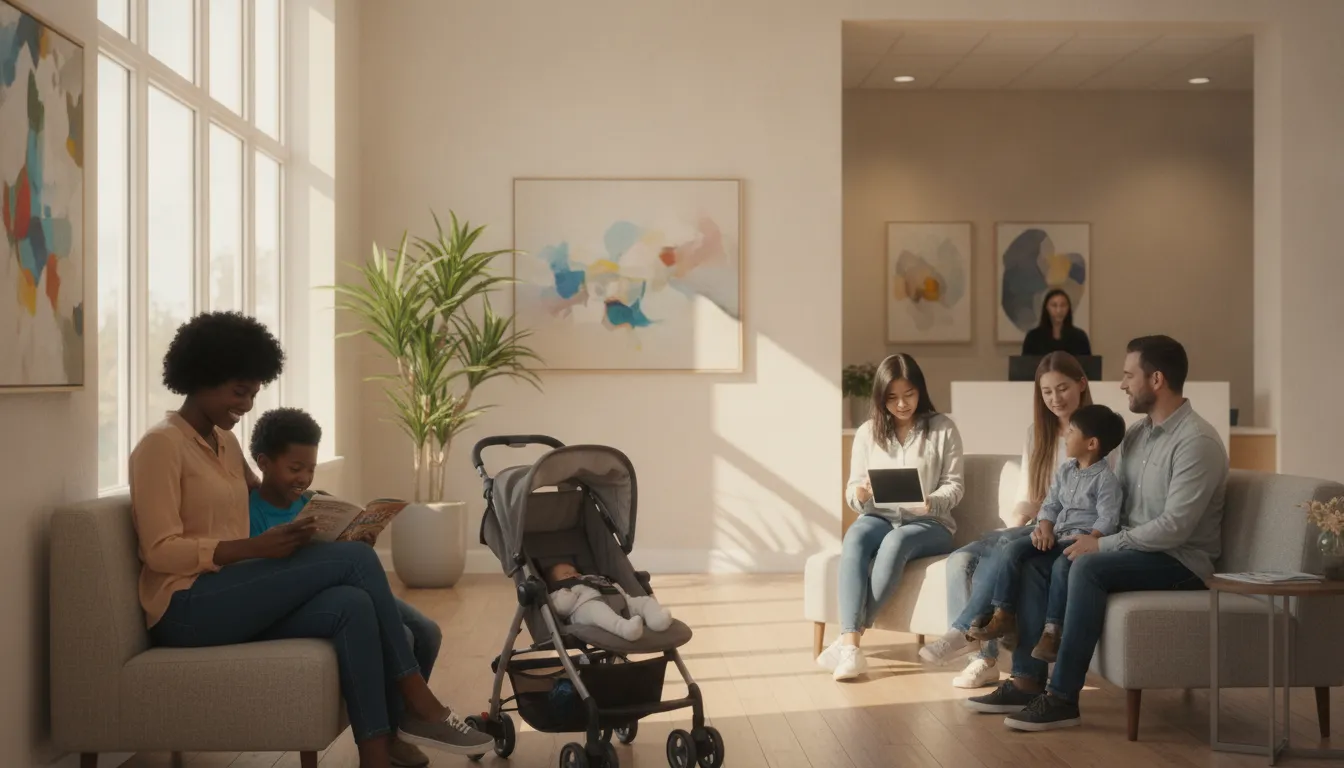
For media buyers, doctor office advertising is not simply a message placed where patients happen to be. It is a place-based opportunity shaped by audience relevance, contextual fit, and time spent in a real-world care environment.
All Points Media helps planners evaluate the setting within a broader media mix. The network can then be built around geography, objectives, creative, and campaign duration.
Talk with All Points Media about a custom campaign, or call (503) 626-0669.
Doctor office advertising gives brands access to health-conscious, insured, and multigenerational audiences during a typical 30 to 60 minute visit, including wait time. The setting can support healthcare, pharmaceutical, insurance, consumer, and community-health messaging when the placement and audience fit are planned carefully.
With 3,521 doctor's-office locations represented in the network, the opportunity is broader than a single waiting room. The planning question is how to use that high-dwell context without confusing presence with guaranteed attention. This guide focuses on the media-buying decisions that shape a regional doctor's-office network, from care setting and placement format through execution and proof of performance.
Why Doctor Office Advertising Is a High-Dwell Media Environment
Doctor's offices combine a relevant audience with predictable time in a physical environment. For media buyers, the value is qualified contextual exposure that can complement digital, audio, and broader out-of-home placements, not guaranteed attention or a substitute for campaign measurement.
Patients and accompanying family members move through a real-world environment with fewer competing commercial messages than they may encounter during a digital session or a broader commute. That does not make every impression equally valuable. It means planners can assess the venue as part of a deliberate media mix, with the setting, message, and audience considered together.
Dwell creates planning opportunity, not guaranteed attention
Typical doctor's-office dwell time is 30 to 60 minutes, including wait time, according to All Points Media's venue analysis. That duration creates room for a message to be encountered across the visit, but it should not be translated into guaranteed attention, engagement, or action. Creative quality, placement, office flow, audience mindset, and frequency still shape the likelihood of meaningful exposure.
All Points Media's venue analysis cites 15,750 impressions per four weeks for doctor's offices. Treat that number as a venue-analysis planning figure, not guaranteed delivery for every campaign. Actual delivery depends on selected locations, campaign duration, format, traffic patterns, and execution. A disciplined proposal separates the planning estimate from the inventory and verification details that define the live buy.
Build around relevance and geography
The network represents 3,521 locations, giving buyers a venue base for building a campaign around audience alignment and geography rather than purchasing an isolated placement. A patient-access initiative may need offices near a provider's service area. A pharmaceutical launch may call for a different footprint from a health-system awareness campaign. The right question is not how many offices are available, but which offices support the objective.
For planners comparing venue types, All Points Media's place-based media strategy can connect doctor's-office inventory with the broader logic of reaching audiences in the environments where daily decisions happen.
Placement Options in Primary Care, Specialist, and Urgent Care Settings
Primary care offices support broad health and household messaging, specialist offices offer more defined contextual relevance. And urgent care settings can align with immediate access and local service needs. Reception, waiting, exam, and restroom placements should be assigned according to the moment, privacy level, and communication objective.
A doctor's office should be planned as a sequence of touchpoints, not a single inventory unit. The care setting changes the audience context, while each physical placement creates a different sightline, dwell pattern, and creative requirement.
| Setting | Role | Priority |
|---|---|---|
| Primary care. | Broad health. | Fast relevance. |
| Specialist. | Context fit. | Clear claims. |
| Urgent care. | Local access. | Respectful guidance. |
Primary care offices
Primary care reaches a broad cross-section of patients and accompanying family members. It can suit health-system awareness, preventive-care messaging, insurance education, pharmacy services, family wellness, and community-health initiatives. Because the audience is broad, creative should establish relevance quickly without assuming a single condition, age group, or treatment journey.
Specialist offices
Specialist environments provide a more defined contextual signal. An orthopedic, cardiac, dermatology, or rehabilitation setting may support a message tied to a relevant service category, provided the advertiser's claims and disclosures receive the appropriate review. Specialist placements require care with tone. Context can improve relevance, but it does not create a physician endorsement or guarantee that a visitor is a qualified prospect.
Urgent care settings
Urgent care offices create a different planning moment because patients may be seeking immediate access, nearby services, or practical next steps. Local health-system messaging, after-hours care information, pharmacy services, insurance education, and community resources may fit when the creative is clear and respectful. The message should acknowledge the setting without exploiting a patient's concern or implying clinical advice.
Match the format to the moment
Reception is a transition point. Creative there should be immediately legible, with a clear brand cue and a message that works while people check in or move through the space. Waiting rooms generally allow more time for narrative, educational framing, or a concise sequence that rewards a longer look without assuming every visitor will engage.
Exam rooms call for a more restrained approach because the setting is private and closely associated with a patient's care. Restrooms offer another defined sightline, but privacy and context remain central. These placements should not receive a design simply because it was used elsewhere in the campaign. Format, viewing distance, message length, and environment need to work together.
Audience Mindset: Patients in Medical Waiting Rooms
Patients in medical waiting rooms are not a generic captive audience. They may be focused on care, accompanying another person, or managing uncertainty. Strong doctor office advertising respects that mindset, keeps the message easy to process, and earns relevance through context rather than overstating attention or clinical authority.
The phrase high dwell describes an opportunity for exposure, not a promise that patients are available for advertising. Some visitors are reading, using a phone, speaking with family, or preparing for an appointment. Others may be receptive to practical information that connects to their health, household, or local community. The media plan should recognize those different states instead of treating every minute as equal.
Use context without overclaiming
Healthcare marketers, insurers, pharmaceutical companies, medical-device manufacturers, and community-health organizations may find the environment relevant because the audience and subject matter can align. That alignment still requires careful review. A placement near a clinical setting is not a clinical endorsement. And a message should not imply that a provider or facility recommends a product unless that relationship is real and approved.
Creative should lead with one clear idea, a recognizable brand cue, and an action that makes sense for the audience. Educational framing can work when it remains concise. A local service-area message can work when the audience can understand where to go next. A consumer message can work when the connection to wellness, family routines, personal care, or everyday health is credible.
Plan for respectful repetition
Doctor office advertising may be encountered at more than one touchpoint during a visit or across repeated visits. Repetition can support recognition, but the same creative should not be placed everywhere without considering fatigue and context. A buyer can use a short message at reception, a more developed message in the waiting area. And a restrained reinforcement in an exam-room environment when the venue permissions and creative specifications support that sequence.
All Points Media identifies healthcare as a core vertical and states that it brings compliance knowledge to regulated industries. That knowledge can inform planning and execution, but it is not a legal guarantee or a substitute for the advertiser's legal, regulatory, medical, or client-side review. Claims, disclosures, audience definitions, and facility approvals remain part of the campaign brief.
For buyers evaluating adjacent healthcare environments, the Healthcare OOH section provides useful context for how a venue network can support an industry-specific media plan.
Which Brands Benefit Most from Doctor Office Advertising?
Doctor office advertising is strongest for brands with a credible connection to patient access, care decisions, wellness, household health, or local services. Healthcare, pharmaceutical, medical-device, insurance, CPG, and community-health marketers can fit, but the brief should define audience, message, compliance review, and geography before placements are selected.
Healthcare and regulated-industry marketers
Hospitals, health systems, provider groups, pharmaceutical companies, medical-device manufacturers, and patient-outreach teams are natural fits. A health system might use the channel to build awareness across its service area. A pharmaceutical or device marketer may introduce a treatment category, support provider awareness, or communicate with patients in relevant care settings. A community-health organization can use the same environment for public education and preventive-health messaging.
Insurance brands also have a logical role when the message connects to coverage education, care access, or plan awareness. The strongest briefs define the communication objective before selecting offices. A campaign focused on patient access may require a different network from one supporting a product launch or broader health-system awareness effort.
Consumer brands with a useful patient-context message
CPG brands can fit when the product or message has a credible connection to wellness, family routines, personal care, or everyday health. The standard is relevance, not simply access to a waiting audience. Creative should respect the setting, avoid clinical overreach, and make the intended action clear without implying endorsement by a physician or facility.
Financial services, retail, and other categories may also be considered when the audience and message fit the environment. The campaign should earn its place in the venue through usefulness or clear relevance. A generic message with no connection to the audience, care setting. Or geography is less likely to justify the placement than a message built around a defined planning need.
How to Set Up a Regional Doctor Office Advertising Campaign
A regional doctor's-office campaign starts with the audience and service footprint, then selects care settings, touchpoints, formats, duration, and creative. All Points Media can connect strategy, production, installation, campaign management, and proof-of-performance reporting so the regional plan remains accountable from design through delivery.
Regional planning starts with the service footprint, not an arbitrary placement count. Define where patients can realistically access care, where a health system is opening or promoting a location, or where a community-health initiative has a defined need. Then build the doctor's-office network around that geography, audience, and campaign objective.
- Define the communication objective and audience in media-buying terms.
- Choose the regional footprint based on patient access, provider coverage, or market need.
- Select care settings, touchpoints, formats, and creative requirements.
- Confirm production, installation, campaign management, and reporting responsibilities.
1. Define the objective and audience
Start with the job the campaign must do. It may support health-system awareness, patient access, a market launch, provider awareness, insurance education, or community-health messaging. Define the audience in media-buying terms, then identify the geographic boundaries that matter to the brief. This prevents a large venue count from becoming a substitute for strategy.
2. Choose the regional footprint
All Points Media operates across all 50 states and 210 DMAs, with access to more than 100,000 leased venues across more than 50 categories. A regional plan may use a state, multi-state region, DMA cluster, city, ZIP code, neighborhood, or trade area. The choice should reflect patient access, provider service areas, market launches, or community-health objectives.
A multi-state footprint may make sense for a coordinated launch, while a DMA cluster can align more closely with media-market planning and local provider coverage. A city or trade-area plan may be more useful when service boundaries are precise. National availability is not, by itself, a reason to buy everywhere.
3. Select settings, touchpoints, and creative
Choose primary care, specialist, and urgent care environments according to audience and message fit. Then assign the role of reception, waiting, exam, and restroom placements. Creative variation should follow a meaningful difference in the market or audience, not create versioning for its own sake. For regulated categories, involve the appropriate review process early.
4. Connect production and installation to the buy
Production and installation are part of the media plan, not administrative details after the buy. All Points Media's service model includes creative production through APM PrintWorks and nationwide installation through AP Installations. Campaign management maintains the operating rhythm after launch, while proof-of-performance reporting documents what was installed, where the campaign ran, and what documentation the buyer receives.
For a broader view of how All Points Media builds campaigns around audience and place, review its place-based media capabilities. For a buyer-side checklist, see how to evaluate a venue sponsorship proposal. The final proposal should state the objective, selected markets, care settings, placements, creative specifications, flight dates, execution responsibilities, and reporting expectations.
Plan a regional doctor's office advertising network with All Points Media, or call (503) 626-0669.
Frequently Asked Questions
Doctor office advertising works best when the media plan defines the audience, care setting, geographic footprint, placement role, creative requirements, and proof-of-performance expectations before the campaign launches.
What types of brands fit doctor's office advertising?
Healthcare marketers, hospitals, health systems, pharmaceutical companies, and medical-device manufacturers are natural fits because the environment aligns with patient education, provider awareness, and community-health messaging. Insurance, consumer packaged goods, financial services, and other brands may also fit when the audience, creative, and venue context support the campaign objective.
Which placements should a media buyer include?
Start with the audience journey and the role of each environment. Reception and waiting areas can support broad awareness, while exam rooms may suit more focused and restrained messaging. Restrooms offer another defined touchpoint. The right mix depends on creative format, message length, venue permissions, geographic coverage, and campaign duration.
Can a doctor's-office network support regional targeting?
Yes. A campaign can be built around a state, multi-state region, DMA cluster, city, ZIP code, neighborhood, or trade area. Media buyers should match the footprint to patient access, provider service areas, a market launch, or a community-health objective, then determine whether regional creative variations are warranted.
What should buyers verify before launching a campaign?
Confirm audience and venue fit, placement specifications, creative requirements, geographic coverage, flight dates, installation responsibilities, and reporting expectations. A turnkey partner should clarify how strategy, production, installation, campaign management, and proof-of-performance reporting connect before the buy is finalized. Healthcare compliance review remains the advertiser's responsibility.
Discuss your doctor's office advertising campaign with All Points Media. Call (503) 626-0669.