
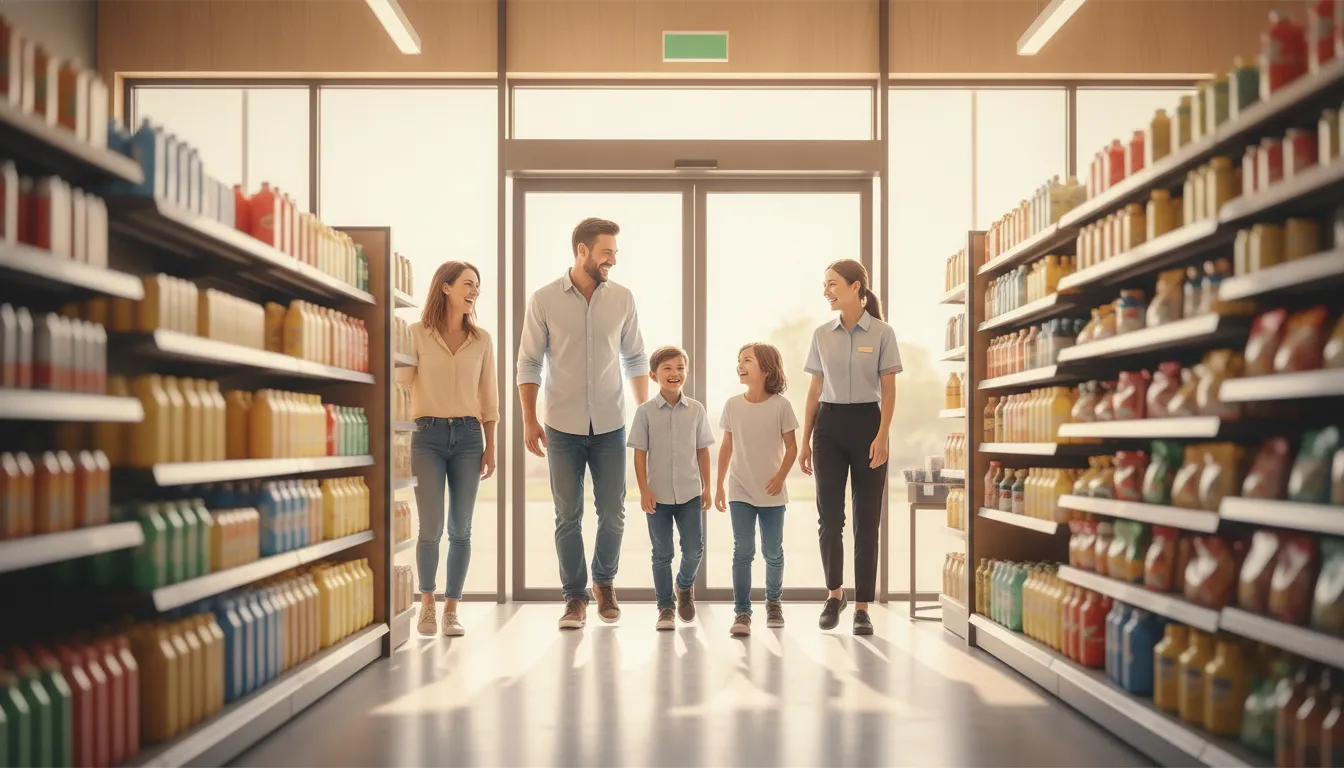
Convenience store marketing campaigns give advertisers something traditional out-of-home placements often cannot: repeated exposure in a setting where people pause, browse, and make everyday purchase decisions. That combination makes the channel useful for brands seeking relevance close to the point of action, not simply another impression along a commute. For consumers, the convenience store is a habitual stop, so the audience returns again and again throughout the week. Which makes each placement work harder than a single roadside view.
Schedule a free campaign consultation with All Points Media to explore whether convenience store place-based media fits your audience and objectives.
Convenience store marketing campaigns use place-based OOH media to reach shoppers during frequent visits and meaningful dwell time. All Points Media describes convenience stores as high-frequency, high-dwell environments. Giving advertisers a practical way to put timely messages in front of consumers where daily routines and purchasing decisions intersect.
The opportunity depends on more than placing creative inside a store. Audience fit, location strategy, format, message timing, and measurement all shape whether a campaign earns attention. Start with the shopper moment itself, then consider how the environment supports a useful, visible brand interaction that supports awareness and conversion in a single media plan.
Why Convenience Store Marketing Campaigns Reach Shoppers at the Right Moment
Convenience stores occupy a useful position in the daily path between need and purchase. Unlike an impression delivered in a passing vehicle. A well-placed message inside a store can meet a shopper while they are already moving through a commercial environment, evaluating products, or waiting to complete a transaction. That context gives media buyers an opportunity to connect awareness with action without relying on traditional billboard inventory alone.
All Points Media identifies convenience stores as high-frequency, high-dwell environments for place-based out-of-home media campaigns. The combination matters. Frequent visits create repeated opportunities for a message to be seen, while dwell time gives the creative a better chance to register. A campaign can therefore build familiarity over multiple encounters instead of treating every impression as an isolated exposure. C-Store advertising can make that recurring environment part of a broader media plan.
Frequency creates cumulative visibility
Convenience store audiences are not defined only by a single visit. They are shaped by routines, routes, and recurring errands. That makes frequency a strategic asset for brands that need to stay present in a specific market or reinforce a message across a defined audience. Repetition can support brand awareness when the creative remains consistent, legible, and relevant to the setting.
For planners, the practical implication is to think beyond a one-time placement. A network of carefully selected stores can help distribute a campaign across the neighborhoods, corridors, or trade areas that matter most. The objective is not simply to put a logo in a store. It is to create a dependable sequence of touchpoints in locations where the audience already spends time.
Dwell time supports a clearer brand message
High-dwell environments give creative more room to communicate than a fleeting roadside exposure. Depending on the placement, shoppers may encounter a message near an entrance, checkout area, cooler, or another point where movement naturally slows. This allows brands to use concise benefit-led copy, strong visual identity, and a clear next step without forcing the audience to absorb a complex message at speed.
That setting can support both upper-funnel and lower-funnel objectives. A campaign may introduce a product, reinforce a seasonal need, direct shoppers toward an offer, or make a brand more familiar before a later purchase decision. The customer-facing environment does not guarantee conversion, but it creates a relevant opportunity to move from recognition toward consideration and action.
Answer capsule: Convenience stores combine frequent visits with meaningful dwell time, giving brands repeated opportunities to build awareness in a relevant setting. Well-planned place-based campaigns use that attention to connect memorable creative with a practical next step. Supporting the path from brand recognition to potential purchase without depending solely on traditional billboard exposure.
Who You Reach: The Convenience Store Shopper Audience
Convenience store shoppers are often moving through a planned errand, a commute, or an immediate need. That context creates a distinct audience for media buyers: people who visit frequently, make decisions quickly, and encounter advertising close to the point of purchase. For brands seeking relevance beyond traditional billboards, the store becomes a practical media environment rather than simply a distribution channel.
Place-based out-of-home media reaches consumers in the environments where daily routines already happen. In a convenience store, an audience may be selecting a beverage, refueling, picking up a snack, or handling a last-minute household need. The visit is brief, but the shopper is physically present and actively choosing among products and messages. That combination gives convenience store advertising formats a useful role in campaigns built around immediacy and context.
Why frequency matters to media planners
Frequent visits can give a campaign repeated opportunities to build recognition. A shopper may see a brand message on one visit, process the offer or product cue later, and encounter it again during another routine stop. This does not make every impression a conversion, but it creates a disciplined path from awareness to consideration and, when the message fits the moment, action. All Points Media positions convenience stores as part of a broader place-based OOH network designed to connect brands directly with consumers.
That environment is particularly relevant for consumer packaged goods and healthcare marketers. CPG brands can align messages with everyday purchasing occasions, while healthcare advertisers can reach consumers in familiar neighborhood settings without relying exclusively on broad, untargeted exposure. The same principle can support financial services, retail, and other categories when the creative is clear, useful, and appropriate to the venue.
From shopper attention to purchase context
Retail marketing strategies can influence customer purchasing behavior in convenience stores, as documented in research on retailer marketing and sweetened-beverage purchases from the University of Minnesota Experts repository. For media buyers, the implication is not to treat the store as a guaranteed sales mechanism. It is to recognize that messages encountered in a retail setting can operate within the same decision environment as the product category itself.
The strongest convenience store marketing campaigns use that proximity thoughtfully. They connect a clear brand promise with a relevant occasion, then extend the message across a network selected for the campaign's audience and geographic priorities. This approach supports both brand awareness and conversion without overstating what any single placement can deliver. It also gives planners a way to make place, timing, and shopper intent part of the media strategy.
Answer capsule: Convenience stores reach frequent, on-the-go shoppers while they are making everyday purchase decisions. Because place-based OOH appears within that retail context, CPG, healthcare. And other brands can build awareness and support conversion with messages tied to relevant occasions, locations, and audience priorities.
Convenience Store Placements: Floor Decals, Counter Media, and Cooler Media
Convenience stores give media buyers access to a physical footprint where shoppers move, pause, browse, and make quick decisions. That makes the environment useful for messages that need more than a passing roadside impression. A campaign can meet the audience at the entrance, along the shopping path, at the register, or beside the product category most relevant to the offer.
Floor and entry placements establish the first impression
Floor decals can turn an otherwise overlooked part of the store into a directional or promotional touchpoint. Positioned near an entrance, aisle, or category destination, they can introduce a message before a shopper reaches the counter. Window media serves a similar role from the exterior, building visibility among people entering the store and the traffic moving past it.
These formats are especially useful when the creative needs to connect a location with an action. A concise message can direct attention to a nearby product, reinforce a seasonal offer, or build awareness for a service available in the surrounding market. The physical setting supplies context that a general audience placement cannot.
Counter, register, and cooler media reach shoppers close to action
Counter media and register displays place the message in a high-attention area, where customers are already completing a transaction or waiting for service. The format can support concise brand reminders, promotional messaging, or a call to take the next step after leaving the store. POS displays can also reinforce a broader campaign that shoppers encountered on the floor or outside the location.
Cooler media brings the message close to a specific category and a product-selection moment. That proximity can make creative feel relevant without requiring a long explanation. Pump toppers extend the footprint beyond the store itself, reaching customers during a brief pause at the fuel island. Used together, these placements create multiple opportunities for recognition across one visit rather than relying on a single sign.
Build the right store network for the campaign
The strongest placement plan starts with strategic venue selection, not a generic list of available units. All Points Media handles custom network building, matching locations and formats to the campaign's geographic priorities, audience, and message. Its turnkey process also includes print production and nationwide installation, helping media buyers maintain consistency across a distributed convenience store program.
For a closer look at the available convenience store advertising formats, consider how each unit supports the shopper journey. A coordinated mix can give the campaign an exterior introduction, an in-store reminder, and a point-of-decision presence while keeping the creative system coherent.
Answer capsule: Convenience store placements put a campaign inside the shopper journey, from window and floor media to counters, coolers, registers, and pump toppers. Strategic venue selection and custom network building help align each format with the audience and market, while nationwide installation keeps execution consistent across locations.
Which Brand Categories Fit Convenience Store Campaigns
Convenience stores can support more than packaged-goods promotions. Their role in everyday routines creates a practical setting for brands that need local relevance, repeated exposure, or a clear connection between message and moment. All Points Media identifies CPG, healthcare, financial services, retail, and government as strong audience categories for place-based media campaigns. With convenience stores providing a direct path into the communities those brands serve.
CPG and retail brands
Consumer packaged goods brands are a natural fit because the surrounding retail environment reinforces the product category. A beverage, snack, personal-care, or household brand can appear close to the point where shoppers are already considering a purchase. Retail marketing strategies in convenience stores have been studied for their influence on customer purchasing behavior, which underscores why context matters at this venue. For brands with a broad distribution footprint, a campaign can combine market-level consistency with creative or placement decisions tailored to individual communities.
Retail advertisers can use the setting to support promotions, seasonal priorities, product launches, or store-level awareness. The strongest executions do not treat every location as interchangeable. They align the message with the audience, trade area, and shopper need, then use a network plan to create consistent visibility across selected venues. For a closer look at available convenience store advertising formats, planners can evaluate how each placement supports the campaign objective.
Healthcare, financial services, and government
Healthcare organizations, financial institutions, and government programs often need to reach people within specific geographic areas. Convenience store media supports that objective through hyper-local targeting, allowing planners to prioritize venues near relevant neighborhoods, service areas, or community corridors. The message can then be written for an action, such as learning about a service. Visiting a local resource, or recognizing a public information campaign, without relying on a broad market buy alone.
These categories also benefit from the venue's high-engagement, everyday environment. A message encountered during a familiar errand can feel more connected to daily life than the same message placed in a context with no relationship to the audience's routine. The convenience store environment therefore creates a contextual advertising opportunity, particularly when the creative reflects the location, season, service area, or immediate consumer need. Research on mobile-based targeting and out-of-home advertising similarly highlights the value of using context to reach on-the-go audiences: contextual targeting can strengthen OOH planning.
Across categories, the planning question is not simply whether a brand can appear in a convenience store. It is whether the venue, message, and geographic strategy reinforce one another. That alignment helps turn a collection of placements into a coordinated campaign built around the audience's real-world environment.
Answer capsule: CPG, retail, healthcare, financial services, and government brands can all benefit from convenience store campaigns. The venue combines high-engagement everyday surroundings with hyper-local reach, helping advertisers match their message to a shopper's location, routine, and immediate context.
Planning a Campaign Across Chains and Independents
Convenience store marketing campaigns rarely need to choose between national scale and local relevance. The strongest plans often use both chain locations and independent stores, assigning each role based on geography, audience, timing, and creative requirements. All Points Media begins with strategic venue selection, then builds a network that supports the campaign objective rather than treating every location as interchangeable.
Chain locations can provide a broad, consistent footprint when the priority is market coverage. Standardized operating procedures and repeatable store layouts may make it easier to deploy the same creative across multiple markets, while established relationships can support a faster rollout. This structure is useful for national or regional advertisers that need a dependable presence across defined territories.
Independent stores contribute a different advantage. Their community presence can help a campaign reach shoppers in specific neighborhoods, towns, or trade areas where a standardized chain plan may leave gaps. Independents may also offer more flexibility for custom placements, local creative, or venue-specific execution. That flexibility is particularly valuable when the message needs to reflect a community, a local service area, or a precise geographic objective.
| Planning factor | Convenience store chains | Independent stores |
|---|---|---|
| Reach | Broad national or regional scale through a standardized footprint. | Concentrated community reach in selected neighborhoods and local trade areas. |
| Planning | Efficient network planning with consistent operating and placement parameters. | More tailored planning around individual markets, store attributes, and local context. |
| Rollout | Repeatable execution can support a faster, coordinated launch across markets. | Flexible execution, with timing and placement adapted to each participating location. |
| Local targeting | Useful for scaling a defined message across priority geographies. | Strong fit for hyper-local targeting and community-specific messaging. |
The mix should follow the media brief. A national consumer brand may use chains as the campaign backbone, then add independent stores around priority markets, retail corridors, or underserved areas. A regional advertiser may reverse that model, using independent locations for precision and chains where additional reach is needed. The right balance depends on the audience, the desired geography, and how much creative variation the campaign requires.
Scale does not have to stop with convenience stores. All Points Media operates across more than 50 venue categories nationwide. That network can also support youth sports advertising, extending a campaign into fields, gyms, and sports complexes where families gather. Strategic selection across that network can connect a brand with consumers in the places and markets that matter most, while preserving a clear rationale for every venue included.
For advertisers that need one partner to coordinate selection, network construction, and execution, turnkey place-based media solutions can reduce the operational burden of managing a mixed chain-and-independent campaign. The objective is not simply to buy more locations. It is to build a coherent footprint that balances scale, speed, flexibility, and hyper-local relevance.
Answer capsule: The best chain-and-independent strategy balances scale with precision. Chains support broad reach and faster standardized rollout, while independent stores add community relevance and flexible local placements. Strategic venue selection helps advertisers combine both models into a coherent convenience store campaign aligned with geography, audience, and creative needs.
Measuring Convenience Store Marketing Performance
Measurement should be designed before convenience store marketing campaigns launch, not added after the creative is installed. A useful framework connects what happens at the venue with the decisions a media buyer needs to make next: which locations to retain. Where to expand, which audience segments to prioritize, and how the campaign supports broader brand objectives.
Start with proof-of-performance
For place-based media, proof-of-performance is a critical campaign deliverable. Reporting should document where the campaign ran, which venues and placements were active, the scheduled flight dates, and whether installation and display requirements were met. All Points Media includes proof-of-performance reporting within its turnkey service, alongside strategic venue selection, network building, production, installation, and campaign management. That operational record gives agencies a defensible answer when clients ask whether the planned inventory was actually delivered.
Build the report around clear KPIs rather than a single headline number. Depending on the campaign objective, the scorecard may include venue coverage, active placement count, delivery by market. Estimated audience exposure, dwell context, brand-lift research, web sessions, branded search, or other conversion signals. The right KPI depends on the role of the campaign in the media mix. Awareness activity should not be judged by the same standard as a campaign built to drive an immediate response.
Connect venue data with audience intelligence
Convenience stores provide a physical context for evaluating reach and engagement. Foot-traffic patterns, visit frequency, dwell behavior, market, daypart, and venue characteristics can help planners understand where an audience is most likely to encounter the message. These inputs are more useful when tied to a defined targeting hypothesis. Such as reaching consumers near a retail corridor or reinforcing a message in markets where a product is distributed.
Data-driven targeting can make out-of-home more precise. Research from Syracuse University describes how mobile-based targeting helps reach on-the-go customers. It also notes how technology automates the sharing of audience and inventory information between buyers and venues: Syracuse University research on mobile-based OOH targeting. Software and workflow tools can improve buying efficiency, but automation should support sound measurement design, not replace it. Planners still need to define the audience, select appropriate venues, establish a baseline, and interpret results in context.
Use analytics to improve the next flight
Review performance by market, venue group, placement type, audience segment, and time period. Compare delivery against the original plan, identify gaps, and document optimization decisions. For a broader framework, see place-based advertising measurement and KPIs. The goal is a repeatable learning loop: verify delivery, analyze audience and response signals, then refine the next network or creative rotation.
Answer capsule: Measure convenience store marketing performance through proof-of-performance reporting, venue and placement delivery, foot-traffic and dwell context, audience targeting, and campaign-specific KPIs. Combine reliable operational records with analytics and automation tools to verify execution, interpret response signals, and make better decisions for the next flight.
How All Points Media Delivers a Turnkey Place-Based Campaign
All Points Media treats convenience store marketing campaigns as an integrated media operation, not a collection of disconnected placements. The process begins with the audience, geography, and campaign objective, then translates those requirements into a network of convenience store environments where consumers spend time during everyday routines.
That high-frequency, high-dwell setting gives brands an opportunity to build repeated exposure close to the point of purchase or another relevant action. The goal is not simply to place a message in a store. It is to create a coordinated presence that can support awareness, engagement, and conversion while giving media buyers one accountable partner from planning through reporting.
1. Select the right convenience store network
Strategic venue selection comes first. All Points Media evaluates the campaign's geographic priorities and identifies the locations that best fit the intended audience and activation plan. A custom network can be built around a market, region, or broader footprint, helping media buyers avoid the compromises that come with an off-the-shelf list of venues.
This network-building approach also supports consistency. The campaign can be designed around a defined group of convenience stores. With the placement mix and geographic coverage aligned to the brief rather than managed as isolated store-by-store decisions.
2. Produce and install the campaign
Once the network is established, All Points Media manages the operational details that often consume agency and brand resources. The turnkey model includes print production and nationwide installation, creating a clear path from approved creative to physical execution in the selected stores.
That coordination matters when a campaign spans multiple markets. Instead of asking a media buyer to manage separate production contacts, venue communications, and installation logistics, one partner manages the moving parts and maintains accountability for delivery. The result is a more controlled rollout and less administrative friction.
3. Manage the campaign and document delivery
Campaign management continues after installation. All Points Media handles the execution as a turnkey advertising partner, simplifying campaign management for media buyers while keeping the program aligned with its original strategy. Proof-of-performance reporting then documents what was delivered, giving stakeholders a clearer record for review and future planning.
For a deeper look at the model, review turnkey place-based media solutions. It explains how venue selection, network building, production, installation, management, and reporting work together as one service.
Answer capsule: All Points Media delivers a turnkey convenience store campaign by selecting strategic venues, building a custom network, producing and installing creative, managing execution, and providing proof-of-performance reporting. This full-service model gives media buyers coordinated access to high-frequency, high-dwell environments without requiring them to oversee every operational detail.
Schedule a free campaign consultation with All Points Media at (503) 626-0669
Frequently Asked Questions
How do convenience store marketing campaigns work?
They place brand messages at relevant shopper touchpoints inside selected convenience stores, such as floors, counters, or coolers. A campaign partner aligns venue selection, creative production, installation, campaign management, and proof-of-performance reporting so media buyers can execute one coordinated place-based OOH program.
What are the benefits of place-based OOH for convenience stores?
Convenience stores can provide frequent, high-dwell interactions in an everyday environment, giving brands an opportunity to reach consumers beyond traditional billboards. The format can also support hyper-local targeting and connect messaging to the context in which shoppers are already making retail decisions. All Points Media describes convenience stores as high-dwell, high-engagement environments.
Which brands are a good fit for convenience store media?
Consumer packaged goods, healthcare, financial services, retail, and government marketers can all evaluate the channel when their audience and geographic strategy align with convenience store traffic. The strongest fit depends on the campaign objective, creative, market, and selected network rather than on industry category alone.
How should marketers measure convenience store campaign performance?
Start by defining the audience, geography, placements, flight dates, and success metrics before launch. Combine delivery documentation and proof-of-performance reporting with appropriate campaign measurement, such as site activity or other approved indicators. Measurement should reflect the campaign objective and avoid treating exposure as a guaranteed sale.
Ready to Plan Your Convenience Store Marketing Campaigns?
A focused consultation can help align venue selection, audience strategy, and campaign execution with your media objectives. All Points Media can discuss a place-based media campaign built around convenience store environments and the practical needs of your brand or agency.
Schedule a free campaign consultation with All Points Media at (503) 626-0669