
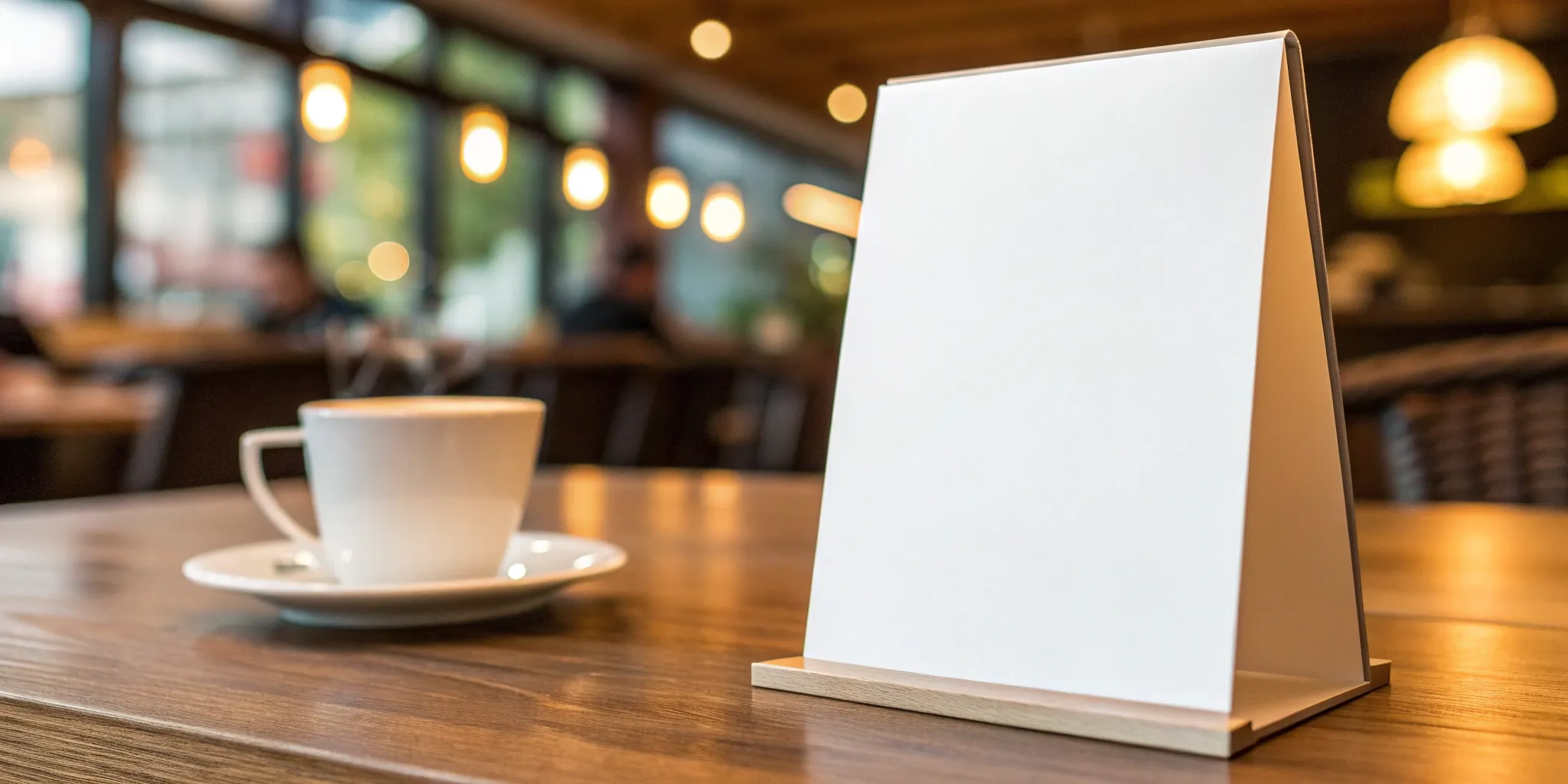
Think of the last time you were waiting for a friend at a cafe or sitting in a doctor's office. Your phone was probably out, but you still glanced around. This is the moment where a powerful, yet often underestimated, marketing tool comes into play. A 5x7 table tent acts like a mini-billboard, placed directly in your audience's line of sight where they live, work, and play. Unlike a massive sign someone drives past in seconds, a table tent connects with a captive audience when they are relaxed and receptive. It’s a direct, non-intrusive way to communicate, making it an incredibly effective tool in any place-based media strategy. This guide will walk you through everything you need to know to create a campaign that cuts through the noise and makes a real-world impression.
Key Takeaways
- Place Your Message in Meaningful Moments: Table tents work best when they reach people in high-dwell environments where they are already relaxed and receptive. Strategic placement in contextually relevant venues ensures your message feels like a helpful part of their experience, not an interruption.
- Combine Smart Design with a Clear Next Step: An effective table tent uses a clean layout and durable materials to grab attention, but its main job is to drive action. Always include a clear call to action, like a QR code or a unique offer, to connect your physical ad to a measurable digital outcome.
- Look for a Partner, Not Just a Printer: The success of a place-based campaign depends on flawless execution. A full-service partner manages everything from strategic venue selection and nationwide installation to performance tracking, delivering a fully managed campaign with verifiable results.
What Are 5x7 Table Tents (And Why Do They Work)?
Think of a 5x7 table tent as a mini-billboard that sits right where your audience is. They're also known as table talkers, and they're designed to capture attention on tables, counters, and reception desks. Unlike a massive billboard someone drives past in seconds, a table tent sits at eye level in high-dwell environments—places where people are spending time, not just passing through.
This is the core of why they're so effective. They connect with a captive audience during moments when people are relaxed and receptive. Whether someone is waiting for a friend at a cafe, sitting in a doctor's office, or unwinding at a community center, your message is right there in their personal space. It’s a direct, non-intrusive way to communicate, making it a powerful tool in any place-based media strategy. They offer a unique opportunity to deliver a targeted message in a contextually relevant setting, cutting through the digital noise to make a real-world impression.
How different industries use them
Table tents are incredibly versatile, making them a smart choice for almost any industry. In healthcare settings, they can share information about new services or wellness tips in waiting rooms. Fitness centers use them at the front desk to announce new classes or personal training specials. Even corporate offices can use them in break rooms to communicate company news or events.
The key is reaching a specific audience where they naturally gather. A table tent allows you to speak directly to consumers in a way that feels personal and relevant to their environment. For a national brand, this means you can tailor campaigns to fit the unique context of each venue, whether it's a family-friendly community center or an upscale salon.
A perfect fit for restaurants and hospitality
Restaurants, bars, and hotels are the natural habitat for table tents. Here, they act as a silent salesperson, sitting directly on the table where customers are making decisions. They’re perfect for telling guests about happy hour deals, seasonal menu items, or dessert specials without a server needing to say a word. It’s a subtle, effective way to upsell and enhance the customer experience.
In the hospitality world, table tents can promote hotel amenities like the spa or room service, or even partner with local attractions to provide guest recommendations. Because they are placed in a setting where people are looking for suggestions and are ready to spend, they can directly influence purchasing decisions and drive immediate sales.
Using table tents for events and promotions
When you need to drive action, table tents are a fantastic tool. They’re ideal for announcing special offers, upcoming events, or limited-time promotions. But you can take it a step further by making them interactive. Including a QR code is a simple way to bridge the gap between your physical ad and your digital presence.
You can use a QR code to direct people to a special landing page, an event registration form, or your social media channels. This creates a direct path for customer engagement and makes your campaign’s success much easier to track. By giving your audience a clear next step, you can create opportunities for interaction that turn passive viewers into active participants in your brand’s story.
Customize Your Table Tents: Materials and Finishes
The design on your table tent is what grabs attention, but the physical materials are what make it last. The right paper, finish, and shape can turn a simple ad into a high-quality brand touchpoint that feels substantial and looks professional. When you're placing ads in busy environments like restaurants, fitness centers, or community hubs, durability is key. You need a product that can withstand a few bumps or a minor spill without falling apart. Thinking through these physical details ensures your message stays crisp and your investment pays off for the entire campaign flight.
Making the right choice starts with the foundation: the paper stock. You can opt for a sturdy, self-standing tent made from heavy card stock, or a printed insert protected by a clear acrylic holder. Each has its place depending on the venue and how often the message needs to be updated. Then there's the finish, which adds both protection and a specific aesthetic. A glossy finish makes colors pop, while a matte finish offers a more subdued, modern feel. For maximum longevity, a protective coating can be a lifesaver, guarding against scuffs and moisture. Finally, don't be afraid to think outside the box with custom shapes and designs that reflect your brand's personality. These elements work together to create a piece that not only communicates a message but also enhances the consumer's experience.
Choosing the right stock: paper, acrylic, and more
First, decide on the format. Many 5x7 table tents are actually paper inserts displayed in a clear acrylic holder. This is a great option for venues that frequently swap out specials or menus, as the holder protects the print. The other common format is a self-standing tent made from a single piece of thick paper, scored and folded into a triangle. For these, you’ll want to use a heavy card stock—at least 100 lb. cover weight—to ensure it stands up properly and feels premium. A flimsy paper tent can look unprofessional and won't last long. Choosing the right paper stock is the foundation for a durable and effective marketing piece.
Selecting a finish for looks and longevity
Once you've chosen your paper, the finish is your next decision. This coating not only affects the look and feel but also adds a layer of protection. A matte finish has a smooth, non-shiny surface that offers a modern, sophisticated look and reduces glare, which is great for text-heavy designs. On the other hand, a gloss finish is shiny and makes colors appear more vibrant and saturated. For extra durability, consider a UV coating, which is a high-gloss liquid applied and cured with ultraviolet light. It creates a hard, protective layer that resists moisture and scuffs, making it ideal for high-traffic areas like bar tops and cafe tables.
Creating a unique look with custom designs
The physical construction of your table tent offers more creative opportunities than you might think. Don't forget to utilize both sides of the tent. This doubles your messaging real estate, allowing you to present a main call to action on one side and supplementary details, like a QR code or social media info, on the other. To truly stand out, consider custom die-cutting to create a unique shape that reflects your brand or product. Instead of a standard rectangle, you could have a tent shaped like your logo or a featured item. Paired with bold typography and vibrant graphics, a custom shape ensures your message won't just be seen—it will be remembered.
How Much Do 5x7 Table Tents Cost?
Figuring out the budget for your table tent campaign involves more than just a simple price-per-unit calculation. The final cost depends on several key factors, including how many you order, the materials you choose, and how quickly you need them. While there isn't a single sticker price, understanding these variables will help you accurately plan your investment and ensure you get the most value from your campaign. Think of it like this: a small, local campaign for a single restaurant will have a very different budget than a nationwide rollout across hundreds of fitness centers. The good news is that table tents are a scalable and cost-effective medium.
Whether you're testing a new promotion or launching a major brand awareness initiative, you can tailor your order to fit your specific goals and budget. This flexibility is one of the main reasons marketers love them. You’re not locked into a massive, expensive buy if you just want to test the waters in a few key locations. On the other hand, if you’re ready to go big, the economics work in your favor. We'll break down the main components that influence pricing—from quantity to customization—so you can confidently map out your next place-based media campaign and present a clear, well-researched budget to your team or client.
What to expect for pricing
One of the biggest factors influencing the cost of your table tents is volume. Like most print advertising, the more you order, the lower your price per piece becomes. This tiered pricing structure is great for marketers because it allows your budget to scale efficiently. For a very small order of a dozen or so tents, you might pay around $2.78 each. However, if you’re planning a larger campaign and order 2,500 or more, that price can drop to as low as $1.30 per tent. This makes table tents an incredibly affordable option for reaching a wide audience, especially when you compare the cost-per-impression to other media channels.
How customization impacts your budget
Your creative choices will also play a role in the final cost. The type of paper stock and finish you select can affect the price. A standard matte finish is typically the most budget-friendly option, while a premium gloss coating for extra shine and durability may add a bit to the cost. If you don’t have a design ready to go, you’ll also want to account for professional design services. While this adds an upfront fee, a compelling, professionally designed table tent is essential for capturing attention and driving results. Think of these choices not just as costs, but as investments in your campaign's overall effectiveness.
Planning your investment
Beyond the materials and design, your timeline is a key part of the investment. Standard production for table tents usually takes between four and eight business days, with shipping adding another two to six days. It’s important to build this lead time into your campaign schedule. If you’re on a tight deadline, some printers offer same-day or rush printing options, but you can expect to pay a premium for the faster turnaround. Planning ahead ensures your materials arrive on time without adding unnecessary costs, allowing for a smooth campaign launch, especially when you work with a full-service partner who handles all the logistics.
Find the Right Partner for Your Table Tents
Your table tent campaign is only as strong as the partner you choose to execute it. While it’s easy to focus solely on the design and the print quality, the right partner does much more than just produce materials. They act as an extension of your team, managing the complex logistics that turn a great idea into a successful, widespread campaign. From ensuring your tents arrive on time to placing them in the most effective locations, your partner’s expertise is the key to getting results. A simple print shop can give you a box of table tents, but a true partner delivers a fully executed campaign.
Think of it this way: you wouldn’t hire a graphic designer to manage your entire media buy. Similarly, for a place-based campaign, you need a specialist who understands the entire lifecycle of the project. This means finding a partner who can handle not just printing, but also strategic network building, nationwide installation, and detailed reporting. They should be able to help you select the right venues, ensure compliance, and provide verification that your message is being seen by the right people. Choosing a partner with a proven track record in managing these campaigns simplifies your workflow and gives you the confidence that your investment is in good hands.
What to look for in a supplier
When you’re vetting potential partners, look beyond the print quote. The first thing to consider is their experience with place-based media. Do they understand the nuances of different venue types? A partner with a deep network and strategic expertise can help you build a custom campaign that reaches your specific audience in the right context. You also need a team that can handle scale and complexity. Ask about their process for managing multi-location rollouts, from production and kitting to shipping and installation. Reliability is everything; you need a partner who guarantees your materials will be professionally placed and maintained throughout your campaign flight.
How All Points Media delivers results
This is where a full-service partner makes all the difference. At All Points Media, we manage every single detail of your campaign so you don’t have to. We aren’t just a printer; we are a complete execution partner for place-based media. We start by working with you to build a strategic network of venues perfectly suited to your target audience. Then, we handle the professional printing, custom kitting, and shipping to every location. Our nationwide field team ensures every table tent is installed correctly and provides photographic proof. This turnkey approach removes the logistical burden from your team, ensuring a seamless and professional execution from start to finish.
Comparing quality and service
When you compare your options, it’s important to weigh the total value, not just the cost per tent. A simple online printer might offer a low price, but they leave the most difficult parts—distribution, installation, and verification—up to you. A full-service partner provides complete accountability. We believe in total transparency, which is why we provide comprehensive proof-of-performance reporting for every campaign. You get detailed insights and photographic verification, so you know exactly what’s happening in the field. This level of service and reporting is essential for measuring your campaign’s impact and demonstrating a clear return on investment to your stakeholders.
Design a Table Tent That Gets Noticed
A table tent is more than just a piece of folded cardstock; it’s a direct line to a captive audience. In high-dwell environments like restaurants, waiting rooms, and fitness centers, you have a unique opportunity to connect with people when they’re relaxed and receptive. But to make that connection, your design has to work hard. It needs to be compelling enough to pull attention away from a smartphone and clear enough to deliver a message in seconds.
Think of your table tent as a mini-billboard that sits right at eye level. The principles of great advertising still apply: be bold, be clear, and be persuasive. A cluttered or confusing design will be ignored, wasting the prime real estate you’ve secured. The best designs balance eye-catching visuals with a message that’s easy to understand at a glance. It’s about guiding the viewer’s eye exactly where you want it to go and giving them a compelling reason to act. We’ll cover the three core elements of a successful table tent design: a clean layout, attention-grabbing visuals, and a powerful call to action.
Create a clean and readable layout
A great design is useless if no one can read it. The key to readability is a strong visual hierarchy that guides the eye through your message. Start with a clear headline in a larger font size, typically between 18–24 pt, to state your main offer or idea. Use subheadings around 12–16 pt to provide supporting details, and keep any body text brief and legible at 10–12 pt. This structure makes your content scannable, allowing people to grasp the key points quickly. Don’t forget the power of white space—giving your text and images room to breathe prevents the design from feeling cramped and overwhelming.
Use color and fonts to grab attention
In a busy environment, your table tent needs to stand out. This is where color and typography come into play. Use vibrant colors and bold typography to make your design pop, but make sure they align with your brand’s identity for a cohesive look. High-contrast color combinations—like dark text on a light background or vice versa—are crucial for legibility. Your font choice also sets the tone. Whether it’s modern and clean or classic and elegant, ensure it’s easy to read from a few feet away. The goal is to create a design that is both visually appealing and instantly understandable.
Craft a clear call to action (CTA)
Your table tent should inspire action. What do you want people to do after they see your message? Your call to action (CTA) needs to be direct, concise, and impossible to miss. Whether it’s “Scan to See the Menu,” “Follow Us on Instagram,” or “Ask About Our Special Offer,” the instruction should be crystal clear. Integrating a QR code is one of the most effective ways to bridge the physical and digital worlds, sending people directly to your website, app, or social media page. To ensure your CTA lands, keep surrounding text brief—ideally under 75 characters per line—so the next step is the main focus.
Get Your Files Print-Ready
A brilliant design concept is only half the battle. To ensure your 5x7 table tents look as crisp and professional in person as they do on your screen, you need to prepare your files correctly for printing. This technical step is your final quality check before your message goes public, and getting it right is essential for avoiding costly reprints. Let's walk through the key steps to get your design ready for a flawless print run.
File formats and resolution explained
To get a sharp, high-quality print, your design file needs the right specs. First, focus on resolution. Your file should be set to 300 DPI (dots per inch), the industry standard for professional printing that ensures your images and text don't look blurry. For color, it’s best to design using the RGB color model and save your final print-ready file as a PDF/X-4. This specific PDF format preserves your color data and ensures compatibility with most professional printers, preventing unexpected color shifts. Getting these technical specifications right is the foundation of a great-looking table tent.
Set up bleeds and margins correctly
A bleed is a small area of your design that extends beyond the final trim line, preventing any unprofessional white edges after cutting. For a 5x7 table tent, you should add a 3mm (or 0.12-inch) bleed on all sides. Just as important is the safe area, or margin, inside the trim line. Keep all your essential text and logos within this margin to avoid them being cut off during production. Remember to also account for the blank assembly tabs in your layout. Setting up your artwork with proper bleeds and margins is a non-negotiable step for a polished finish.
The importance of proofing your design
Before you send anything to the printer, take the time for one last, thorough review. Proofing is more than just a spell-check. Print out a copy to see how it looks and feels in your hands. Read every word out loud. Does the layout make sense? Is the call to action clear? This is also the perfect time to test any interactive elements. If you’ve included a QR code, scan it to ensure it works correctly. A well-placed QR code is a powerful tool for bridging your physical media with a digital experience, allowing you to track engagement and measure your campaign's impact.
Place Your Table Tents for Maximum Impact
A brilliant design is only half the battle. Where you place your table tents is just as crucial to your campaign’s success. The right location ensures your message reaches a captive audience at the perfect moment, turning a simple piece of cardstock into a powerful marketing tool. Strategic placement isn't about cluttering a space; it's about integrating your message seamlessly into the consumer's environment. Let's look at how to find the perfect spots for your table tents, tailor your approach to the venue, and keep your campaign engaging over time.
Find the sweet spot: where to place your tents
Your goal is to be seen without being in the way. On counters and reception desks, place your table tent where customers naturally pause, like next to the credit card machine or sign-in sheet. For dining or waiting areas with shared tables, a good rule of thumb is to limit yourself to one tent for every two feet of space to maintain clarity and avoid a cluttered look. This gives your message room to breathe and makes it more likely to be noticed. Think about the customer's line of sight. Are they looking down at a menu, or straight ahead while waiting? Position your tent to meet their gaze naturally. The sweet spot is where visibility is high, but the tent doesn't interfere with the customer's primary activity.
Tailor placement to your venue
Every environment offers unique opportunities. The key is to match your placement strategy to the venue and the audience's mindset. In a restaurant, a table tent on every table promoting a happy hour special is a no-brainer. But in a doctor's office waiting room, you might place them on end tables to share helpful health tips or information about new services. This is the core of effective place-based advertising—connecting with people during meaningful moments. Think about why someone is in that specific location. Are they there to work out, relax, or eat? Use that context to your advantage. A well-placed table tent feels less like an ad and more like a helpful suggestion that enhances their experience.
Keep your campaign fresh
A table tent that never changes eventually becomes invisible. To keep people engaged, you need to give them a reason to look. This is where interactive elements come in. Adding a simple QR code can direct customers to a special landing page, a contest entry form, or a social media profile. You can use them to gather customer feedback or build your email list. Consider rotating your offers or designs every few weeks or months, especially for long-term campaigns. A new headline or a different color scheme can be enough to catch the eye of a regular customer. By keeping your content dynamic, you ensure your table tents continue to work for you long after they’re placed.
Measure the Success of Your Table Tent Campaign
Just because your campaign lives in the physical world doesn’t mean you have to guess at its impact. With a little planning, you can measure the effectiveness of your table tents just as you would a digital ad. Tracking performance is key to understanding what resonates with your audience, proving your investment's value, and making smarter decisions for future campaigns. It transforms your table tents from a simple brand placement into a responsive marketing tool. Here’s how to get started.
Key metrics to track
To get a clear picture of your campaign's success, focus on a few core metrics. Start with the engagement rate—the percentage of people who interact with your ad by scanning a QR code, using a discount code, or visiting a special URL. Next, you’ll want to understand your return on investment (ROI), which tells you if the value generated by the campaign was worth the cost. Finally, keep an eye on social media mentions. If people are posting about your campaign or using your hashtag, it’s a great sign that you’ve created something memorable and extended your reach organically.
Simple ways to track engagement
Tracking engagement doesn’t need to be complex. The most straightforward method is to incorporate QR codes on your design that link to a specific landing page. By using a trackable link, you can see exactly how many people scanned the code. For more detailed insights, use different QR codes for different venues. Another great option is to feature a unique promo code or a custom, easy-to-remember URL. These direct-response tools make it simple to connect a physical ad to a digital action, giving you clear, quantifiable results that demonstrate campaign performance.
How to improve your campaign's performance
Once the data starts coming in, use it to refine your strategy. The best way to do this is through A/B testing. Try running two versions of your table tent in similar venues—perhaps with different headlines or calls to action—to see which performs better. Regularly review your engagement metrics to spot trends. Are QR scans higher in cafes than in fitness centers? Use these insights to double down on what works. You can also encourage social sharing by adding a unique hashtag or running a contest, turning your audience into active participants and advocates for your brand.
Related Articles
- Digital Mobile Truck Billboard | All Points Media
- TriStar Summit - Digital Out of Home Advertising - All Points Media
- T-Mobile - Digital Out of Home Advertising - All Points Media
- CDC - Digital Out of Home Advertising - All Points Media
- Petsmart 6 - Digital Out of Home Advertising - All Points Media
Frequently Asked Questions
Why should I use table tents when most of my budget is in digital advertising? Think of table tents not as a replacement for digital ads, but as a powerful way to ground your campaign in the real world. While digital ads are great for broad reach, they also compete with endless online distractions. A table tent connects with people in a physical space where they are relaxed and attentive, creating a focused, screen-free moment for your brand. It’s a perfect complement that reinforces your online message and reaches audiences in a tangible way that digital simply can't.
What’s the real difference between using a full-service partner and just ordering from an online printer? An online printer will send you a box of beautifully printed table tents, but their job ends there. The most challenging part—getting those tents into the right venues across the country—is left entirely to you. A full-service partner like All Points Media manages the entire process. We help you build a strategic network of venues, handle all the printing and shipping logistics, ensure professional installation, and provide photographic proof that your campaign is running as planned. It’s the difference between buying a tool and hiring an expert to complete the project for you.
How can I be sure my table tents are actually displayed correctly across hundreds of locations? This is one of the most critical questions for any multi-location campaign, and it’s where accountability is key. A true partner provides comprehensive proof-of-performance. We use a nationwide field team to not only install your table tents but also to capture photographic evidence from every single venue. You receive detailed reports that verify your message is being displayed correctly, giving you complete confidence and transparency for your investment.
Can I target very specific audiences with a table tent campaign? Absolutely. That’s the core strength of place-based media. The targeting comes from strategically selecting the venues themselves. If you want to reach health-conscious consumers, we can build a network of fitness centers and wellness clinics. To connect with families, we can place your message in community centers and pediatric offices. By defining your audience, we can create a custom network of locations that aligns perfectly with their daily lives, ensuring your message is seen in a highly relevant context.
Beyond a QR code, what makes a table tent design truly effective? An effective design passes the "glance test." Someone should be able to understand your main point in just a few seconds. This means having one clear, compelling headline, using a clean layout with plenty of white space, and choosing colors and fonts that are easy to read from a distance. The goal isn't to cram in as much information as possible, but to present a single, powerful idea with a clear call to action that inspires curiosity and makes someone want to learn more.